Meta Quest 3S Gorilla Tag Bundle: What VR Beginners Get Wrong
The Gorilla Tag bundle gets dismissed as a marketing gimmick. For a first-time VR buyer it solves the onboarding problems that make people quit headsets.
ReviewHubNow Editorial Team
ReviewHubNow Editorial Team
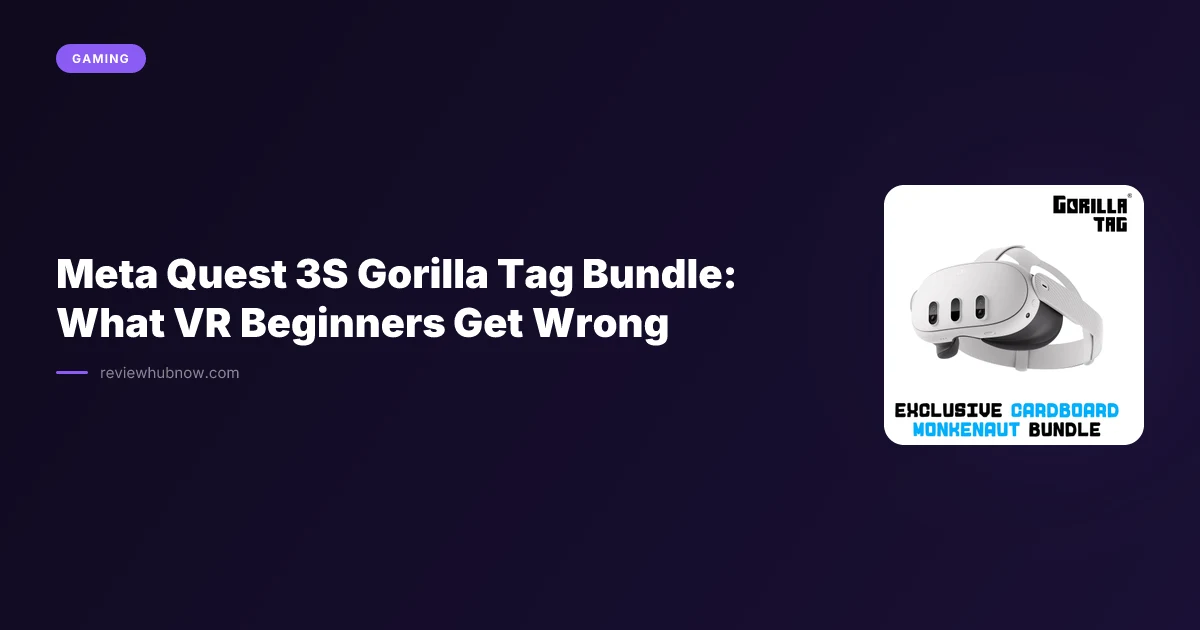
The common take on the Meta Quest 3S is that the Gorilla Tag bundle targets children, and that anyone serious about VR should buy the headset on its own. It sounds reasonable and it misreads what makes a first headset succeed or gather dust.
For a specific buyer, this is one of the better value bundles Meta has run. Understanding what it does well, and where the criticism genuinely applies, decides whether it suits you.
Is Gorilla Tag just a kids' game?
It looks like one, with low-poly legless primates for avatars, and mechanically it is among the best onboarding experiences VR has produced. That was not the design intent, it is a consequence of how the game moves you.
Locomotion works entirely through hand-over-hand climbing, so new users learn room-scale movement, hand tracking and spatial awareness without ever touching a joystick.
That matters because locomotion is the single largest hurdle for VR beginners, and the source of the nausea and confusion behind every story about trying VR once and abandoning it. Physical movement instead of stick movement sidesteps the problem, and beginners who get the most from a headset in the first month are usually the ones who started with a game demanding actual body movement.
Do you need a gaming PC to use the Quest 3S?
No, and the belief is a holdover from the Quest 2 era when standalone performance genuinely limited what would run well and most people tethered their headset to a PC. The Quest 3S uses the same Snapdragon XR2 Gen 2 chip as the Quest 3, and standalone performance covers the games most beginners actually play.
PC-linked VR retains its place for anyone chasing the fidelity of the most demanding titles. Buying a first headset to discover whether VR appeals to you and then tethering it to a gaming rig defeats much of the purpose.
The appeal here is putting the headset on and being inside, with no cables, no separate VR platform setup and no troubleshooting a USB port that refuses to negotiate the right data rate. Beginners abandon VR because setup friction wore them down far more often than because graphics disappointed them.
Is the larger storage option worth paying for?
For anyone planning to build a library, yes, and the reason is specific. VR games are far larger than their flatscreen equivalents because they render two camera views simultaneously along with higher-resolution textures to compensate for lenses sitting close to the eyes.
A handful of major titles consumes the smaller storage tier faster than buyers expect, frequently within a couple of months of regular use.
Hitting that ceiling means constantly uninstalling and reinstalling, which on a standalone headset means multi-gigabyte downloads over Wi-Fi every time you switch games. The larger tier is not a luxury option so much as the one that avoids a recurring irritation nobody mentions upfront.
Will VR make you motion sick?
It depends almost entirely on the game rather than on VR itself, which is why this fear keeps more people from buying than it should. Nausea correlates strongly with locomotion type. Smooth analogue-stick movement, common in shooters ported from flatscreen, produces most reported sickness because the inner ear reports stillness while the eyes report motion.
Titles built around physical or teleport movement rarely trigger that conflict. Gorilla Tag is entirely physical. Beat Saber is stationary. Many beginner-friendly Quest titles were designed with this constraint in mind, since Meta has encouraged developers to prioritise comfort options.
The worst experiences almost always come from starting with a demanding stick-based shooter. Beginning with a physical-movement game and letting the vestibular system adapt across a few sessions resolves the problem for most people within a week or two. Anyone who feels unwell should stop rather than push through, since discomfort is a signal rather than a hurdle to overcome.
Should you buy the bundle?
For a genuine beginner who has never owned a headset and is unsure whether VR will stick, yes. It addresses more real onboarding problems than a standalone purchase does: a locomotion-friendly first game, standalone convenience that removes setup friction, and storage headroom that postpones the library ceiling.
The value drops sharply for anyone upgrading from an existing headset, or buying primarily for PC-linked flight simulators and narrative titles. Those buyers should price-match the standalone unit instead.
This is a beginner's bundle and does not pretend otherwise, which it accomplishes better than the surrounding discourse suggests. A set of budget gaming headphones pairs well for spatial audio without disturbing the house, and anyone building a dedicated play space with a spectator display will find our gaming monitor guide useful, since the same panel considerations carry over.
Editor's Pick
Affiliate link. We may earn a commission if you buy through it, at no extra cost to you.

More from Our Editors
Meta Quest 3S 512GB vs 256GB: How Much Storage Do You Actually Need?
By ReviewHubNow Editorial Team
Do You Need a Soundbar With a Built-In Subwoofer for a Small Room?
By ReviewHubNow Editorial Team
Ottocast Mini Cube 3.0 vs CarlinKit: Which Adapter Should You Buy?
By ReviewHubNow Editorial Team