Skullcandy Crusher Evo: What the Bass Research Actually Says
Haptic bass sounds like a gimmick until you read the psychoacoustics. Here is where the research backs it up, and where the gaming marketing runs past the science.
ReviewHubNow Editorial Team
ReviewHubNow Editorial Team
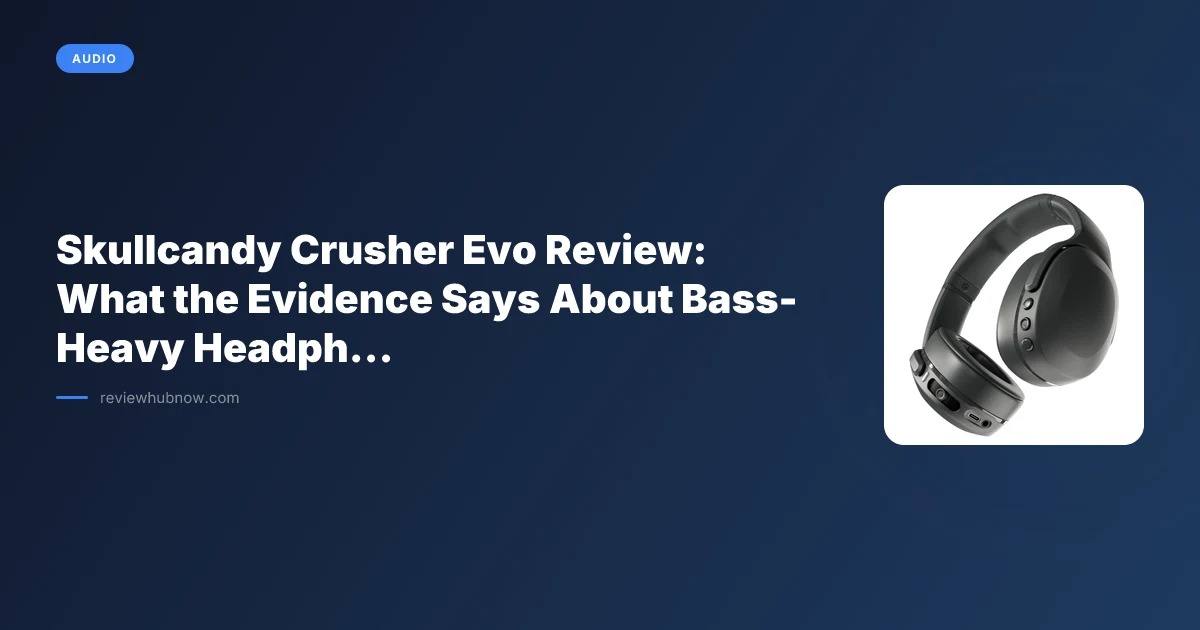
Audio purists have a favourite headphone to dislike, and right now it is the Skullcandy Crusher Evo. The reason is a pair of haptic drivers in the earcups: small motors that vibrate against your head in time with bass frequencies. One camp treats this as the smartest idea in consumer audio in years. The other treats it as a party trick for people who do not know what accurate sound is.
Both readings miss what the research says, and the disagreement is worth untangling because it applies to every bass-forward headphone on the shelf rather than to this one model. Below is what the literature on sound signature preference, tactile bass and positional audio supports, and where Skullcandy's marketing outruns it.
Why are bass-heavy headphones so polarizing?
The argument is older than this product. It sits between reference sound, meaning flat and accurate to what the mixing engineer heard, and consumer-preferred sound, meaning boosted bass and treble with slightly recessed mids. Harman International has run large listener preference studies for decades, and the repeated finding is that untrained listeners across different cultures prefer a bass-elevated curve to a flat one, even when they are told which is technically accurate.
That is not a fringe result. It is one of the more reliably replicated findings in audio psychoacoustics, and it explains why so many popular headphones ship tuned this way.
So when someone calls a bass-heavy headphone wrong, what they usually mean is that it is not neutral. That much is true. It does not follow that most listeners will enjoy it less, and those two claims get conflated constantly in reviews.
What does the haptic bass driver actually do?
It adds a physical sensation rather than changing what you hear. The Crusher Evo puts bass haptic drivers in the earcups, separate from the audio drivers, with a slider on the left cup controlling intensity. At zero it behaves as a conventional, still quite bass-forward headphone. Turned up, kick drums and explosions register as pressure against your skull.
There is genuine science underneath this. Feeling low frequencies as vibration engages somatosensory pathways alongside hearing, which is the same reason a subwoofer in a room feels more physical than headphones playing the identical track. Research on multisensory integration in audio perception indicates that adding a tactile component to bass can raise perceived loudness and impact without increasing actual sound pressure level.
What no research supports is the idea that this reveals detail or improves accuracy. It does neither. It layers a sensation on top of an already bass-forward tuning. To Skullcandy's credit, the specifications do not claim otherwise, even where the promotional video gets carried away.
Which music suits this sound signature?
Genres built around low end suit it well: hip-hop, EDM, reggaeton and a lot of contemporary pop production. The mid-bass emphasis complements how those tracks are mixed, and the haptic layer adds something conventional bass-forward headphones cannot reproduce. For workouts and commutes, that is a genuinely enjoyable combination.
Acoustic and densely arranged material is where it struggles. Jazz, orchestral recordings and a lot of classic rock lose ground because elevated bass masks midrange information, vocals sit further back, and cymbal and string texture flattens out.
This is exactly the trade-off the Harman work describes. Boosted curves win for casual enjoyment while critical listening, where the goal is hearing everything a mix contains, suffers under them. Listening for pleasure makes this a non-issue. Caring what the mix engineer intended makes it a persistent irritation. Headphones tuned closer to a balanced consumer curve, such as the Sony WH-CH720N or Beats Studio Pro, handle vocal-forward and acoustic material with more clarity and give up the visceral low-end hit in exchange.
Are bass-heavy headphones good for gaming?
For immersion yes, for competitive play no, and the marketing tends to blur the two. Positional accuracy in shooters depends on clean midrange and upper-frequency detail, because footstep cues sit roughly in the 1 to 5kHz band rather than in the sub-bass region this tuning emphasises. Elevated bass can obscure those cues through frequency masking, where energy in lower bands reduces perceived clarity in adjacent ones.
Where this tuning genuinely earns its place is cinematic single-player gaming. Explosions and score in a big-budget action title land closer to a home theatre experience than headphone gaming usually manages, and the haptic layer is a real part of that. Competitive shooters are the opposite case, where directional precision decides outcomes and mushy footsteps cost you rounds.
Anyone playing ranked shooters should look at a flatter tuning. Anyone who wants games to feel like an event is well served here.
Can bass-heavy headphones be better for your hearing?
Possibly, and it is the angle most reviews skip. Because perceived fullness satisfies the ear at lower volume, a bass-forward signature can reduce the urge to turn things up, while thin bass-light headphones invite volume increases to compensate. Given that listening volume and duration drive noise-induced hearing loss, anyone who habitually cranks the dial to fix a thin sound may do their ears a favour with a warmer tuning. This is a modest benefit rather than a health feature, and it does not license loud listening.
Who should buy the Crusher Evo?
Bass-genre listeners, commuters who want fun rather than reference accuracy, and players of cinematic single-player games get real value from it. Build quality is solid, Skullcandy rates battery life at around 40 hours, and the haptic slider is genuine differentiation rather than a marketing checkbox.
Skip it for competitive gaming, for vocal-forward or acoustic listening, or if muddiness in a mix bothers you. In that case a more balanced tuning, along the lines of the Beats Studio Pro and Sony ANC comparison, will serve you better over time even though nothing about it rattles your skull on first listen.
Editor's Pick
Affiliate link. We may earn a commission if you buy through it, at no extra cost to you.

More from Our Editors
Meta Quest 3S 512GB vs 256GB: How Much Storage Do You Actually Need?
By ReviewHubNow Editorial Team
Do You Need a Soundbar With a Built-In Subwoofer for a Small Room?
By ReviewHubNow Editorial Team
Ottocast Mini Cube 3.0 vs CarlinKit: Which Adapter Should You Buy?
By ReviewHubNow Editorial Team