What Our Research Found
The question here is narrow and worth getting right. At $15.99 for 100 tips, is a 30 gauge 1/2 inch dispensing needle the right gauge for the jobs people actually buy these for? Gauge choice is the whole decision. Get it wrong and you either flood your workpiece or spend the afternoon poking a wire down a blocked tip.
30 gauge is the narrowest practical dispensing size, roughly 0.16 mm of internal bore, which is why it excels with thin cyanoacrylate, ink and alcohol-based fluids and jams almost immediately with anything viscous.
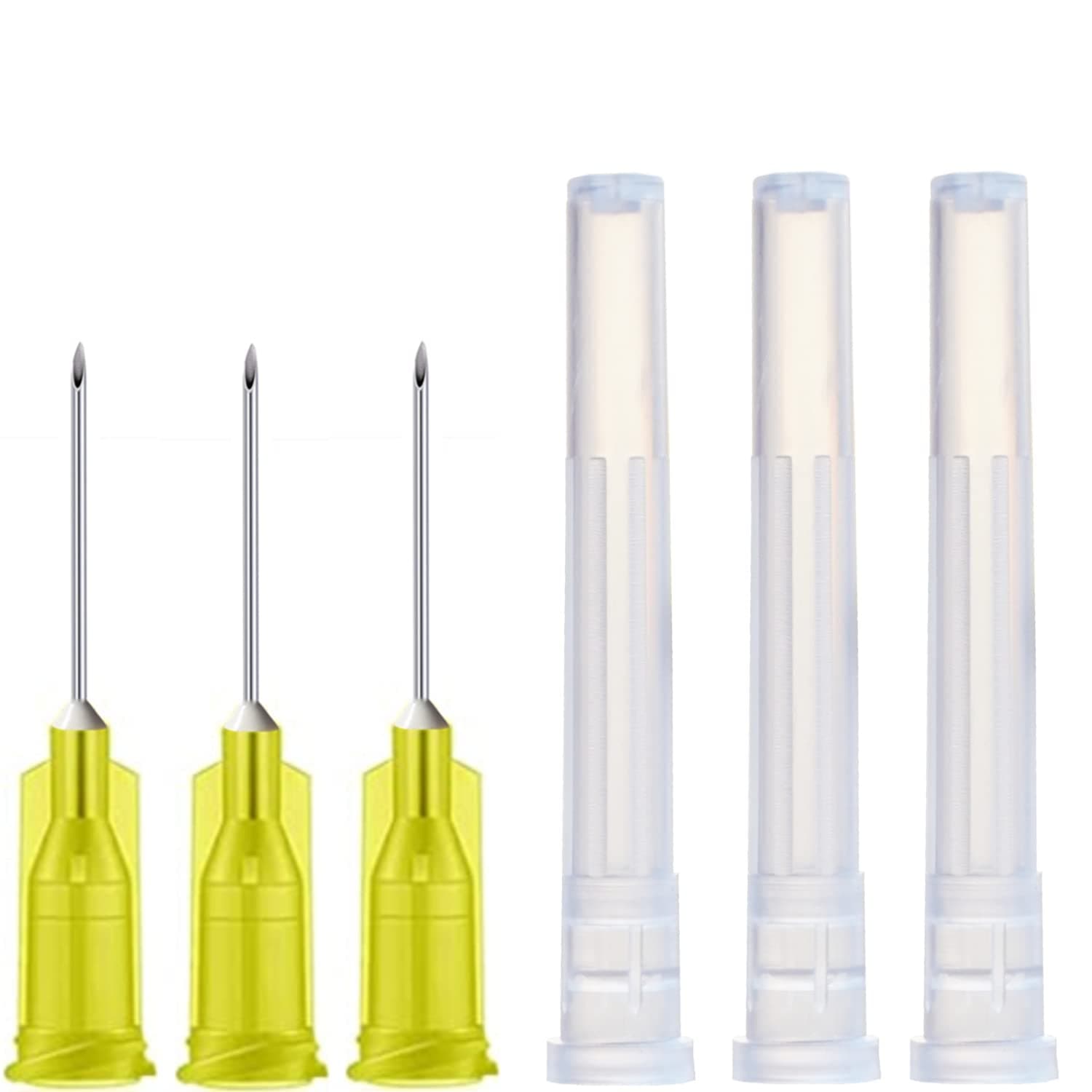
Four specs matter: gauge, length, hub type and sterility. At 30G the outer diameter sits around 0.31 mm with an inner bore near 0.16 mm, so flow is slow and highly controlled. The 1/2 inch (12.7 mm) length stays rigid and resists bending, unlike the 1 to 1.5 inch tips people often buy by mistake. The Luer lock hub threads onto standard syringes rather than pressing on, which matters the moment you apply hand pressure to a plunger, because press-fit tips can pop off. Individual sterile packaging is real, though for glue and ink work sterility is beside the point. It's useful mainly for lab, aquarium or reptile feeding tasks. What the listing doesn't tell you is the steel grade, the hub plastic type, or whether the tips resist solvents like acetone and MEK. All undisclosed, and it's the single biggest gap in the product information.
Bottom line
For thin liquids these do the job at a price where a clogged tip costs about 16 cents. That's the practical argument for a 100-pack: you don't clean them, you replace them. For thicker media you need 18G to 25G, and buying this pack instead will waste your money no matter how well it's built.
Buy them if your work is fine-detail and your fluid is watery. Skip them if you're doing PCB paste, RTV silicone, thick epoxy, or if you assumed these were injection needles. They're blunt dispensing tips and are not intended for piercing skin. Treat every tip as single-use, and dispose of used tips the way you'd handle any sharps: in a rigid, sealed container rather than loose in household rubbish.
Why does 30 gauge clog when 25 gauge doesn't?
We assessed this pack the way any dispensing tip should be judged: gauge-to-viscosity match, hub standard, rigidity at the stated length, and unit economics. Gauge follows the Birmingham/Stubs system, where higher numbers mean narrower tubing, and 30G sits near 0.31 mm outside with a bore around 0.16 mm. Flow through a narrow tube falls away steeply as that bore shrinks, since Poiseuille's relationship puts flow rate in proportion to the fourth power of radius. The step from 25G to 30G is therefore nothing like a small one, and a fluid that moves easily through the wider tip can simply refuse to budge through this one at hand pressure.
The Good & The Bad
thumb_up What We Loved
- check
Genuinely fine control for thin liquids
At a 0.16 mm bore you can lay a thread of CA glue along a seam or place a single drop of flux on a pad without flooding neighbouring components. No bottle nozzle gives you that.
- check
Luer lock beats press-fit under pressure
Fine gauges create back pressure, and back pressure is what pops slip-tip needles off mid-job. The threaded hub keeps the tip seated even when you're leaning on the plunger.
- check
The quantity is the feature
A hundred tips at roughly 16 cents each changes how you work. You stop nursing a clogged needle and fit a fresh one, which is faster and produces cleaner results. Each tip is single-use by design.
thumb_down Honest Drawbacks
- close
30G clogs fast, and often permanently
This is the defining limitation. Cyanoacrylate cures inside the bore within minutes of idle time, and thickened or filled fluids won't pass at all. Expect to burn through tips, which is exactly why they're sold in hundreds.
- close
Wrong gauge for most adhesive work
Epoxy, silicone, solder paste, thick PVA and anything carrying particulate filler need 18G to 25G. Plenty of buyers order 30G on the assumption that finer is better and end up with an unusable pack.
- close
Materials and chemical compatibility undisclosed
No stated steel grade, no hub polymer, no solvent resistance data. For a product routinely used with solvents and reactive adhesives, that omission matters and the manufacturer should publish it.
- close
Blunt tips, frequently mistaken for hypodermics
These are dispensing needles with flat, non-bevelled ends. They're not intended for injection or piercing skin, and buying them for medical use is the wrong call — that requires proper medical-grade product and, in many cases, professional oversight. If the reason you clicked was hypodermic use, read the U.S. FDA home sharps guidance we've linked in our sources: it describes what actual sharps handling and disposal involves, and none of it applies to a blunt dispensing tip.
Technical Breakdown
Needle gauge
30G (≈0.31 mm outer diameter, ≈0.16 mm bore)
Needle length
1/2 inch (12.7 mm)
Hub type
Luer lock
Quantity and unit cost
100 pieces, ≈$0.16 each
Material and solvent resistance
Undisclosed
How It Works
These are consumables, not a tool. Setup takes seconds. Technique decides whether you get clean lines or a mess.
Match the needle to your fluid first
Check viscosity before you open the pack. 30G suits thin CA glue, ink, isopropyl-based fluids, flux and light oils. Anything that doesn't pour freely at room temperature needs a wider bore.
Fill the syringe, then attach
Draw or pour your fluid into a Luer-compatible syringe first, then fit the tip. Filling through 30G is slow and pulls in air. Purge one drop to clear the line.
Twist to lock
Push the hub on and rotate about a quarter turn until it seats on the Luer lock threads. Snug is enough. Over-torquing a plastic hub cracks it or strips the thread.
Dispense with steady, low pressure
Slow, constant plunger pressure only. Let the bead touch the work and wick off the tip. Jerky pressure gives you a blob, then nothing.
Use each tip once, then dispose of it
Cap it or bin it as soon as you finish. These are single-use consumables. Cure-in-place fluids set inside the bore within minutes, and clearing a hardened 30G tip is rarely worth the attempt.
How It Compares
| Feature | 100 Pcs 30 Gauge 1/2 Inch Sterile Disposable Dispensing Needles | BSTEAN mixed-gauge blunt-tip dispensing needle kit |
|---|---|---|
| Gauge | 30G, finest practical bore, ~0.16 mm | An assortment spanning coarse through fine gauges in one box |
| Best-suited fluids | Thin CA glue, ink, flux, alcohol solutions, light oils | Broader range, since you can step up to a wider bore for medium-viscosity adhesives |
| Length | 1/2 inch (12.7 mm), rigid, stays on line | Kits generally include longer tips, trading rigidity for reach |
| Hub | Luer lock (threaded) | Luer lock on most kit tips, though some kits mix in slip-fit parts |
| Quantity | 100 pieces, ≈$0.16 each | Far fewer tips overall, split across several gauges |
| Clog resistance | Poor by design, replace rather than clean | Better, because a wider gauge is always in the box |
| Packaging | Individually sealed, sterile | Usually supplied in a storage case or bulk bag rather than sealed singles |
Frequently Asked Questions
Are blunt dispensing needles sharp enough for injections?
No. These are blunt-tip dispensing needles with flat, non-bevelled ends, designed to apply fluids rather than pierce anything. They're not intended for injection or any medical use, and buying dispensing tips for that purpose is unsafe. If you need injection equipment, get proper medical-grade supplies through appropriate channels.
Will a 30 gauge dispensing needle work with super glue?
Thin cyanoacrylate only. Standard watery CA flows through a 30G bore fine and lays a hairline bead, while gel or thickened CA won't pass at hand pressure at all. Cure time inside the needle is short, so cap or bin the tip the moment you finish rather than leaving it loaded on the bench.
Do Luer lock dispensing needles fit any syringe brand?
Barrel volumes from 1 mL up to 60 mL all take the same fitting, so one pack covers every syringe size in your drawer. These use Luer lock, the threaded standard most syringe brands build to regardless of who made the barrel, and the hub seats with about a quarter turn.
What's the biggest downside of 30 gauge dispensing tips?
Clogging, and it isn't close. A 0.16 mm bore blocks with anything thicker than water, and once an adhesive cures inside, that tip is finished. This is physics rather than a manufacturing fault, but it means the pack only earns its money if your fluid is genuinely thin. Epoxy, silicone or paste want 18G to 25G.
Is a mixed-gauge assortment kit a better buy than a single-gauge pack?
If you're setting up a bench for the first time and don't yet know which gauge your work needs, an assortment is the better first purchase, because matching tip to fluid drives results more than anything else. Buy this 100-pack once you already know 30G is your working size and want the volume to discard clogged tips freely.
What's the return policy for these dispensing needles?
Not stated on the listing. Marketplace purchases generally fall under the platform's standard returns window, often around 30 days, but that's a general policy assumption on our part rather than a confirmed term for this pack, and opened consumables are often handled differently. Verify the specific listing and seller page before ordering.
library_booksReferences & Further Reading
Our reviews are informed by peer-reviewed research and authoritative health organizations. These sources provided context for this review:
- linkISO 80369 — Small-bore connectors for liquids and gases (Luer lock and Luer slip fittings)
- linkU.S. FDA — Safely using sharps (needles and syringes) at home, work and travel (cited for the hypodermic-vs-blunt-tip distinction)
- linkHealth Canada — Medical devices and consumer product safety information
Editorial note: Links to external sources are provided for informational purposes. ReviewHubNow is not affiliated with these organizations and does not receive compensation for linking to them.
This is a good pack of tips for a narrow job. Laying thin CA glue on a model seam, refilling ink cartridges, placing flu...
Based on our research and analysis, 100 Pcs 30 Gauge 1/2 Inch Sterile Disposable Dispensing Needles scored 7.6/10. See the full verdict above for who it suits — and who should pass.
View Price on Amazon Canadaarrow_forwardVerify official availabilityWhat Owners Report
Recurring themes we found across public owner reviews.
Owners doing fine detail work, model kits, printer cartridge refills and board-level repair, repeatedly report that the fine bore gives them control they couldn't get from a bottle nozzle, and that the threaded hub stays put under pressure.
The dominant negative theme is clogging. Buyers using thicker adhesives or letting CA sit in the tip describe needles blocking after a single session, with cleaning attempts rarely working.
A steady stream of reviews comes from people who expected sharp injection needles and received blunt dispensing tips instead, a mismatch of expectation rather than a fault with the product itself.
Unverified for this listing. No separate manufacturer warranty is advertised, and we could not confirm return terms from the product page itself. Marketplace purchases usually fall under the platform's general returns window — commonly around 30 days — but treat that as a broad assumption, not a promise attached to this pack. Opened or partly used consumable packs are often handled differently, so check the listing's stated return terms and the seller's own policy before ordering.