What Our Research Found
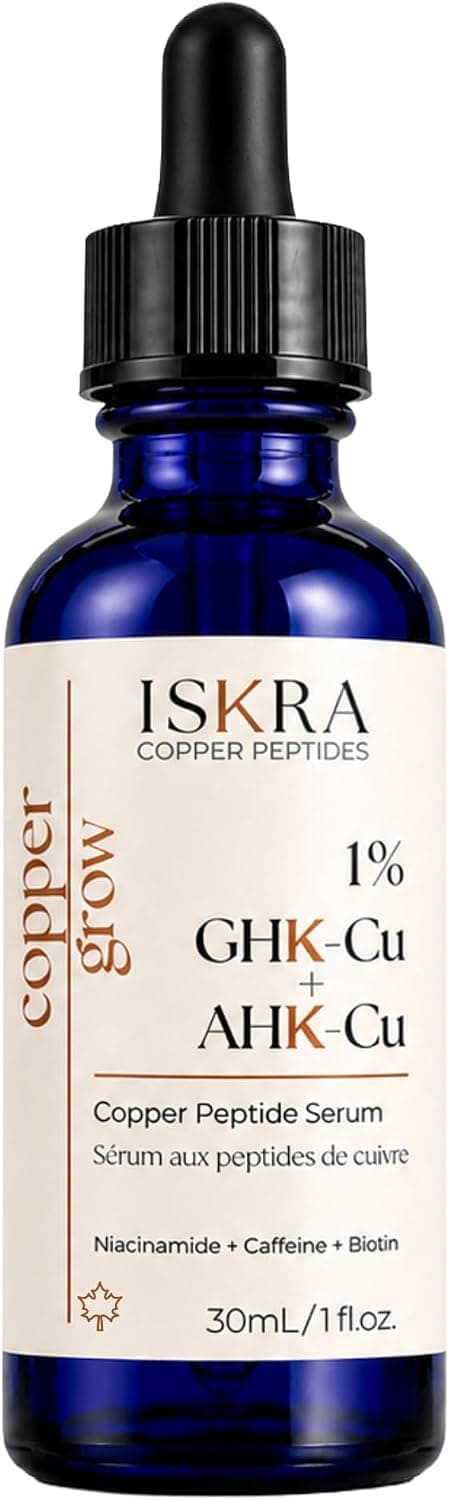
Copper peptides are having their hair moment. GHK-Cu jumped from wound-care research to skincare to scalp serums, carried by mechanistic plausibility and a wave of social-media before-and-afters. Copper Grow offers the trend at 1%, with AHK-Cu alongside. We drew the line between what's known and what's hoped.
Here's the evidence status, plainly. GHK-Cu has legitimate laboratory and wound-healing research behind it, along with follicle-relevant mechanisms that make the hypothesis reasonable. What doesn't exist yet is the decisive part: robust clinical trials proving that topical scalp application regrows hair in humans. That's a categorically different tier from approved treatments, and no amount of enthusiasm closes it.
Within its cosmetic lane, the product makes defensible choices. 1% is a substantial concentration for the category, the GHK-Cu and AHK-Cu pairing follows peptide-stack convention, and leave-in scalp application maximizes contact time. The 4.8-star early aggregate skews toward scalp-feel improvements, reduced-shedding impressions, and satisfaction with hair texture. Those are subjective outcomes consistent with good scalp conditioning, which this formula genuinely provides whether or not the peptides do anything at all.
Bottom line
At roughly $33 CAD this is a modest-cost experiment with plausible upside and honest uncertainty attached. Anyone dealing with genuine androgenic loss should anchor on clinically proven options and add this only as a complement.
It suits the optimizer who enjoys running informed experiments. It should not carry anyone's primary hair-loss hopes. That job belongs to evidence and, ideally, a dermatologist.
Is there real science behind copper peptides for hair?
GHK-Cu is a copper-binding tripeptide with a real research pedigree. Wound-healing studies, collagen-synthesis signaling, and laboratory work suggesting follicle-relevant effects together form the mechanistic story that launched the trend. What the literature lacks is the decisive tier: randomized human trials showing that topical scalp application grows hair. That absence doesn't make the hypothesis false. It makes products like this experiments, honestly priced ones.
The Good & The Bad
thumb_up What We Loved
- check
Honest dosing for the category
1% copper peptides is a real concentration. Trend ingredients usually arrive at a fraction of that, present mostly so the label can name them.
- check
Genuine scalp conditioning
Whatever the peptides eventually prove, owners consistently report calmer, better-feeling scalps. That part is a real cosmetic deliverable.
- check
Reasonable experiment price
Roughly $33 CAD buys months of a plausible-mechanism trial, which keeps the size of the bet proportionate to the uncertainty around it.
- check
Enthusiastic early owner base
The 4.8-star aggregate reflects strong subjective satisfaction, led by texture and shedding impressions.
thumb_down Honest Drawbacks
- close
The core claim is unproven
No robust human trials show that topical GHK-Cu regrows hair. Mechanism and hope are running well ahead of clinical evidence.
- close
Early reviews measure feelings
Scalp feel and shedding impressions are exactly the outcomes placebo excels at. A 4.8 aggregate on a young product measures enthusiasm.
- close
Opportunity cost for real hair loss
Six months spent on an experiment are six months not spent on a treatment that works. That's the quiet risk of buying the trend first.
- close
Copper staining and interactions
Heavy use can discolor light hair. The serum also shouldn't share application time with strong acids or direct vitamin C, so routine placement matters.
- close
No concentration breakdown between the two peptides
The label gives you 1% for the complex, not a split between GHK-Cu and AHK-Cu. You're trusting the ratio you can't see.
Technical Breakdown
GHK-Cu
Part of 1% peptide complex
AHK-Cu
Part of 1% peptide complex
Concentration
1% peptide complex
Format
Leave-in scalp serum
How It Works
A leave-in scalp routine. Consistency over months is the only honest test.
Apply to a clean scalp
Dispense onto the scalp in sections rather than through the hair lengths. The target tissue is the follicle environment, not the strand.
Massage in, leave in
Fingertip massage distributes the serum. Nothing gets rinsed, so contact time runs as long as it wants.
Commit to daily consistency
Hair cycles run for months, so any real assessment window is three to six months. Photos beat memory every time.
Track honestly, escalate if needed
Progressive thinning deserves a dermatologist and proven therapy. The serum can ride alongside that, never instead of it.
How It Compares
| Feature | Copper Grow serum | Clinically proven treatments |
|---|---|---|
| Evidence tier | Mechanism + early anecdotes | Randomized human trials |
| Primary use | Cosmetic scalp experiment | Medical hair-loss therapy |
| Cost of trial | ~$33 CAD | Varies; often comparable monthly |
| Risk profile | Low (cosmetic) | cancelKnown, monitored |
| Best role | Complement | Foundation for real loss |
Frequently Asked Questions
Does GHK-Cu actually regrow hair, or is it just marketing?
No robust human trials show that topical GHK-Cu regrows hair on the scalp. The laboratory research is real, and so are the follicle-relevant mechanisms it suggests, but mechanism is not proof. Approved hair-loss treatments sit in a completely different evidence tier, and nothing in this bottle changes that.
Is Copper Grow worth trying for thinning hair?
If you already use a proven treatment and want to add something speculative on top, yes. The 1% concentration is real dosing, roughly $33 CAD is proportionate to the uncertainty, and the scalp conditioning happens either way. As anyone's primary answer to thinning hair, no. See a dermatologist first.
How long until copper peptide serums show results?
Three to six months of daily use, because hair cycles run on that clock and nothing shorter tells you anything. Take dated photos from the start; memory is a terrible instrument here. Scalp-feel improvements show up within weeks, but those are conditioning effects, not regrowth.
Can I use copper peptides with my other hair products?
Generally yes, with two cautions. Keep it away from strong acids and direct vitamin C in the same application, since that interaction degrades the copper complex. Heavy long-term use can also tint very light blonde or gray hair. Regular shampoos, conditioners, and proven treatments coexist with it fine.
Copper peptides vs minoxidil for hair loss: which should I choose?
Minoxidil, if you have to pick one. Decades of randomized trials and regulatory approval sit behind it; copper peptides have mechanism and enthusiasm. For genuine thinning, the proven treatment is the foundation and a peptide serum is the optional thing running alongside it.
What's the biggest weakness of copper peptide scalp serums?
The distance between what the category promises and what it has proven. Early reviews measure scalp feel and shedding impressions, which are exactly the outcomes placebo is best at producing. A 4.8 aggregate on a young product tells you owners are pleased, not that peptides are working.
library_booksReferences & Further Reading
Our reviews are informed by peer-reviewed research and authoritative health organizations. These sources provided context for this review:
- linkNIH/PubMed — GHK-Cu peptide research literature
- linkAmerican Academy of Dermatology — Hair loss treatment guidance
Editorial note: Links to external sources are provided for informational purposes. ReviewHubNow is not affiliated with these organizations and does not receive compensation for linking to them.
Copper Grow executes the copper-peptide experiment properly. The concentration is real, the format is right, the price i...
Based on our research and analysis, Copper Grow 1% GHK-Cu + AHK-Cu Scalp & Hair Serum scored 6.9/10. See the full verdict above for who it suits — and who should pass.
View Price on Amazon Canadaarrow_forwardVerify official availabilityWhat Owners Report
Recurring themes we found across public owner reviews.
Scalp feel and texture lead the early reviews. Owners describe calmer, less flaky scalps and fuller-feeling hair within weeks, with shedding impressions close behind.
The patient minority names the real problem: months in, they can't separate serum effects from ordinary seasonal variation in their own hair.
Skincare-literate buyers dominate the reviews. Many describe adding it to routines already anchored by proven treatments, which is the right framing.
Amazon Canada's standard 30-day return policy