What Our Research Found
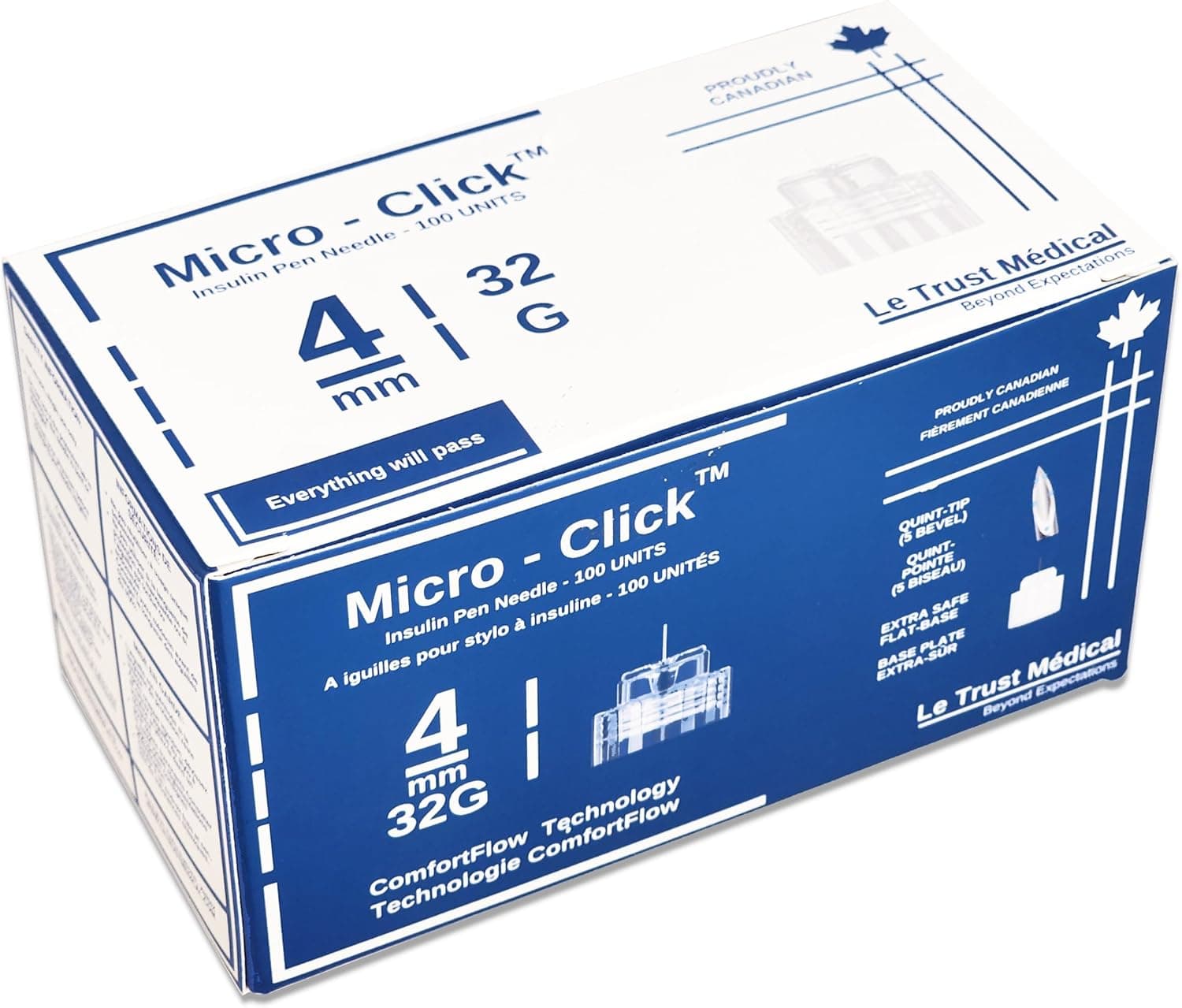
Pen needles are the least glamorous recurring purchase in modern medicine, and with injectable medications surging, third-party 100-count boxes like this one exist because brand-name needles cost multiples more at the pharmacy counter. We assessed what the spec sheet means in practice and where caution genuinely belongs.
The spec logic is straightforward. 4mm and 32-gauge sits at the comfort-forward end of the needle spectrum, since shorter and thinner tracks with less injection discomfort, and clinical guidance has broadly moved toward shorter needles for subcutaneous pen injections in most adults.
The design is the standard universal screw and click mount used across major pen platforms, with each needle individually sealed and capped for sterility. A 100-count box at around $20 CAD works out to pennies per injection, which is the entire third-party value case in one number. The 4.6-star aggregate suggests real-world fit and function hold up across common pens. The caveats are structural to the category rather than specific to this brand: 'universal' compatibility is near-universal rather than absolute, needle-length choice belongs to your clinician, and single-use plus proper sharps disposal is non-negotiable safety practice.
Bottom line
As a cost-saving consumable for established pen users, the spec and the price are both right. The two-minute diligence of confirming fit on your pen and length with your pharmacist is what separates a smart saving from a false economy that costs you more than money.
It belongs in the supply drawer of users who have confirmed the fit on their own pen. It does not replace medical guidance on injection technique, site rotation or needle length, and nothing in this review should be read as clinical advice.
Why has injection guidance moved toward shorter 4mm needles?
We assessed these needles against the factors that govern pen-needle selection: gauge and length, where 4mm and 32G aligns with the shorter-and-thinner direction of modern subcutaneous injection guidance for most adults, alongside sterility packaging, mount compatibility across major pen platforms, and per-unit economics for daily users.
The Good & The Bad
thumb_up What We Loved
- check
Comfort-forward spec
The 4mm and 32-gauge combination is what users switching from longer, thicker needles most often describe as a genuine comfort upgrade.
- check
Bulk price at pennies per injection
A 100-count box at around $20 CAD undercuts pharmacy-counter brand needles dramatically for anyone injecting daily, which is where the running cost actually bites.
- check
Individually sealed sterile units with a broad fit record
Proper per-needle caps and seals are the non-negotiable baseline, and owner feedback reports them executed correctly. The 4.6-star aggregate is dominated by confirmed fit on common insulin and GLP-1 pens.
thumb_down Honest Drawbacks
- close
'Universal' still requires verification
Some pen models seat third-party needles imperfectly, and a needle that doesn't seat properly can dose incorrectly. Confirm the fit on your own pen and with your pharmacist before you commit to a box of 100.
- close
Needle length is a clinical decision, not a shopping one
Four millimetres suits most adults for subcutaneous injection, but your prescriber's specification for your body and your medication overrides any review, any spec sheet and any price advantage. If your care team specified a different length, buy that length.
- close
Third-party trust is earned box by box
Pharma-brand needles carry tighter institutional quality-control reputations built over decades. Inspect the seals on each unit and never use a needle whose packaging has been compromised.
- close
The savings evaporate the moment anyone reuses one
A low per-unit price only stays safe alongside strict single-use discipline. Stretching needles across injections to save a little more is the false economy that causes real harm, through dulled tips, added pain and contamination risk.
- close
Disposal adds a cost and a chore the listing doesn't mention
Every used needle needs an approved sharps container, and filled containers need returning to a pharmacy or a municipal program. Buyers new to injectables often don't budget for that, and household garbage is never an acceptable shortcut.
- close
No substitute for injection training
This review can tell you about a needle's gauge, length and price. It can't teach technique, site rotation or what to do when a dose feels wrong, and those belong to your care team rather than to a product listing.
Technical Breakdown
Gauge
32G (very thin)
Length
4mm
Count & sterility
100, individually sealed
Mount
Universal click-on
Brand provenance
Third-party
How It Works
A standard pen-needle routine, where the discipline matters considerably more than the hardware does.
Confirm compatibility once, properly
Check that the needle seats correctly on your specific pen model, and ask your pharmacist to confirm it. 'Universal' covers the major platforms, but yours is the one that has to work.
Click on a fresh needle for every injection
Attach a new sterile needle each time. Reuse dulls the tip, hurts more and risks contamination, so single-use is the rule rather than a suggestion you can bend when the box runs low.
Inject using the technique you were taught
4mm needles are designed for subcutaneous delivery without pinching up in most adults, but follow the technique your care team taught you for your specific medication.
Dispose in an approved sharps container
Used needles go into an approved sharps container, never into household trash or recycling. Pharmacies in Canada commonly accept filled containers for safe disposal.
How It Compares
| Feature | Micro-Click 100-count | Pharmacy brand-name needles |
|---|---|---|
| Spec | 32G x 4mm universal | Same specs available |
| Price per needle | Pennies | Several times more |
| Compatibility | Universal, verify your pen | Platform-matched |
| Sterility packaging | Individually sealed | Individually sealed |
| Best for | Cost-conscious users who have confirmed fit | Zero-diligence assurance |
Frequently Asked Questions
Are Micro-Click 32G pen needles worth buying in a 100-count box?
For established pen users who confirm fit first, yes. The 4mm and 32-gauge combination at pennies per sterile needle is the third-party category doing its job properly. That diligence isn't optional, though: verify your pen model and your prescribed needle length with your pharmacist before you commit to a 100-count box.
Do Micro-Click needles fit Ozempic and other semaglutide pens?
They use the universal mount that common semaglutide and insulin pens accept, and owner feedback confirms fit across the widely used platforms. Some rarer pen models seat third-party needles imperfectly, which is why you should test a single needle on your exact pen and ask your pharmacist to confirm compatibility before relying on the box.
Is a 4mm insulin pen needle long enough for most adults?
Four millimetres is long enough for most adults, because modern injection guidance has moved toward shorter needles for subcutaneous pen delivery, and 4mm reaches the correct tissue layer without pinching up in typical technique. Your prescriber's length specification for your body and your medication overrides any general answer here, including this one.
Can I reuse an insulin pen needle to save money?
No. Pen needles are single-use. Tips dull and take on microscopic damage after one injection, which raises both pain and contamination risk with every reuse. The safe way to save money is the per-unit price of a bulk box like this one, never by stretching individual needles across multiple injections.
How do I dispose of used insulin pen needles in Canada?
Used needles go in an approved sharps container, never into household garbage or recycling, because they count as biohazardous sharps. Pharmacies across Canada commonly provide the containers and take filled ones back, so ask yours which local return program it participates in before your first box runs out.
What is the biggest risk with third-party insulin pen needles?
Compatibility edge cases are the real risk. The word 'universal' covers the major pen platforms rather than every model perfectly, and a poorly seated needle can deliver an incorrect dose. Two minutes confirming fit on your own pen with your pharmacist is what protects both the savings and your safety.
library_booksReferences & Further Reading
Our reviews are informed by peer-reviewed research and authoritative health organizations. These sources provided context for this review:
- linkDiabetes Canada — Injection technique resources
- linkHealth Canada — Safe sharps disposal guidance
Editorial note: Links to external sources are provided for informational purposes. ReviewHubNow is not affiliated with these organizations and does not receive compensation for linking to them.
These needles get the fundamentals right, with the comfort-forward 4mm and 32-gauge spec, sealed sterility and a bulk pr...
Based on our research and analysis, Micro-Click 32G 4mm Universal Insulin Pen Needles, 100 Count scored 7.5/10. See the full verdict above for who it suits — and who should pass.
View Price on Amazon Canadaarrow_forwardVerify official availabilityWhat Owners Report
Recurring themes we found across public owner reviews.
Fit-and-comfort reports dominate the feedback. Owners on common insulin and GLP-1 pens repeatedly confirm clean attachment and less sting than they got from longer needles.
The rare negative feedback clusters on specific pen models seating imperfectly, which reinforces the advice to verify your own pen before buying in bulk.
Price relief is the recurring storyline, with daily injectors describing meaningful monthly savings against pharmacy-counter needles.
Amazon Canada's standard 30-day return policy