What Our Research Found
Sleep trackers fail for one unglamorous reason: people stop wearing them. We looked at the Withings Sleep to test the premise behind it. Does moving the sensor off your body and under the mattress produce data you'll still be collecting six months from now?
Compliance is 100% by design. Once the pad is under the mattress, every night gets tracked with no effort, no charging, and nothing touching your skin.
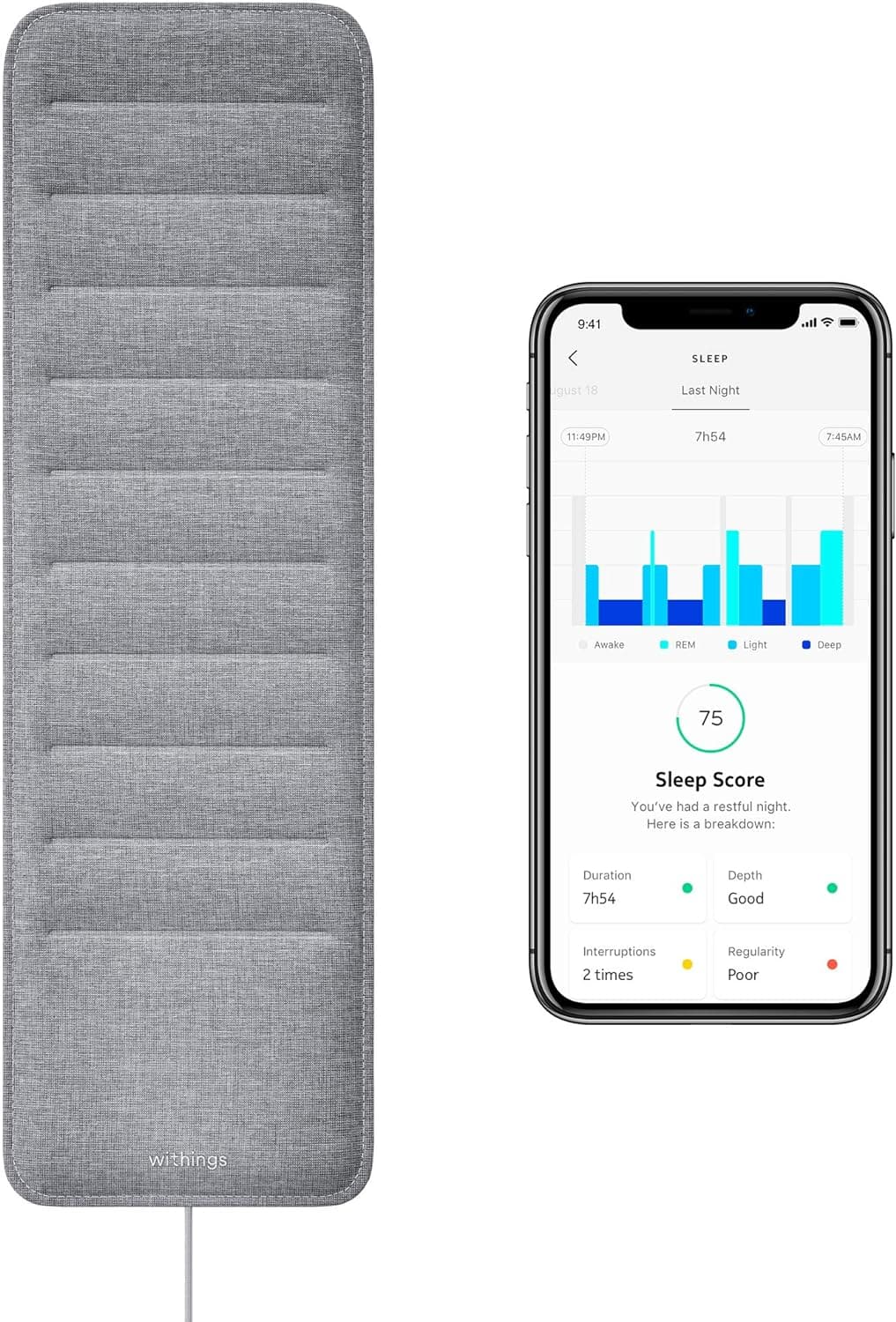
A pneumatic sensor reads micro-movements through the mattress: heart rate, breathing rate, body movement, and sound-based snore detection. It works through mattresses roughly 4 to 15 inches thick and plugs into the wall, so there is no battery to charge, ever. Data goes over Wi-Fi to the free Health Mate app, which grades each night with a Sleep Score and breaks the night into light, deep, and REM cycles. Setup runs about 10 minutes including a firmware update, and the pad calibrates itself across the first few nights.
Bottom line
What you get in practice is consistent nightly trends, covering sleep duration, regularity, interruptions, snoring episodes, and a breathing-disturbance signal. Those are genuinely useful for spotting patterns. What you trade is precision on exact stage timing compared with lab polysomnography, and every consumer tracker makes that same trade.
Buy it if you want effortless long-horizon sleep data, particularly if the IFTTT and smart-home triggers appeal. Skip it if you already wear a watch or ring to bed and like it, because you'd be paying for a second opinion on nights you're already recording.
How accurate is an under-mattress sleep tracker, really?
We evaluated the Withings Sleep on the questions that decide whether an under-mattress tracker is worth owning. What signals does it actually capture? It reads movement, heart rate, breathing rate, and acoustic snoring. How does it turn those into sleep stages? By inference, using patterns in those signals. And how does that compare with wearables reading from the wrist or finger? Ballistocardiography, meaning the reading of the body's micro-movements through a surface, is an established technique for heart and breathing rate. Its consumer trade-off is that stage classification leans harder on inference than a device touching your skin does.
The Good & The Bad
thumb_up What We Loved
- check
Zero-effort compliance
Abandonment is what kills most sleep trackers. A pad plugged in under the mattress keeps collecting for years without you thinking about it once.
- check
Snore and breathing-disturbance detection
It logs snoring episodes with timestamps and duration, and its breathing-disturbance signal can be an early prompt to talk to a doctor. Most basic trackers skip both.
- check
No battery, no skin contact
Nothing on your wrist or finger, no charging cable rotation, nothing to lose. That matters for people with skin sensitivities and for anyone who finds wearables disruptive at night.
- check
Smart-home and health-app integration
IFTTT bed-entry and bed-exit triggers, plus Apple Health and Google Fit sync, keep the data portable rather than trapped in one app.
thumb_down Honest Drawbacks
- close
Sleep-only device
A smartwatch at a similar price also tracks workouts, steps, and daytime heart rate. This pad does one job, so if you want metrics around the clock it isn't the value pick.
- close
Stage accuracy is estimated, not clinical
Like every consumer tracker, its light, deep, and REM split is inferred from movement, heart, and breathing signals. Useful for trends. Not evidence for a diagnosis.
- close
Wi-Fi and app required
No display, no local readout. If the app or your network goes down, the night's insights wait, and long-term history lives in Withings' cloud rather than on the device.
- close
Per-side tracking only
It tracks one sleeper. Data for two people means buying and installing a second pad on the other side of the bed.
- close
Sync hiccups turn up in owner reports
The most repeated complaint is a morning where the app takes a while to surface the night. Rare, but irritating for anyone who checks their score with coffee.
- close
It follows the bed, not you
Travel, guest rooms, and hotel stays produce nothing. People who sleep in different beds often will find gaps in the record that a wrist device wouldn't leave.
Technical Breakdown
Tracking method
Under-mattress pneumatic sensor
Metrics
Cycles, HR, snoring, breathing
Power
Wall outlet (no battery)
App dependency
Health Mate + Wi-Fi required
Coverage
One sleeper per pad
How It Works
Setup happens once and takes roughly 10 minutes. After that the pad disappears from your life entirely.
Slide the pad under your mattress
Position it horizontally at chest level under your side of the bed. It reads through most mattress types, roughly 4 to 15 inches thick, memory foam included.
Plug in and pair
Connect the pad to power, pair it with the free Health Mate app over Bluetooth, and hand it your Wi-Fi network. The app walks you through a short self-calibration.
Go to sleep
Tracking runs automatically from the first night. Each morning the app shows a Sleep Score, your cycles, heart rate, snoring episodes, and any breathing disturbances.
Optional: automate the bedroom
Through IFTTT, getting into bed can kill the lights or drop the thermostat, and getting out can start the coffee maker. It also syncs to Apple Health and Google Fit.
How It Compares
| Feature | Withings Sleep | Wrist wearable (e.g. Fitbit) |
|---|---|---|
| Effort per night | cancelNone, it's under the mattress | Must wear and charge regularly |
| cancelSnore detection | check_circleYes, with timestamps | Usually absent or phone-based |
| Daytime health metrics | cancelNone | Steps, workouts, 24/7 heart rate |
| Charging | Never (wall powered) | Every few days |
| Best for | Set-and-forget night data | All-day health tracking |
Frequently Asked Questions
Is the Withings Sleep pad worth it if I already own a fitness watch?
Yes, if what you want is consistent night-after-night data with nothing to wear and nothing to charge. It's the wrong buy if you already sleep with a watch or ring you're happy with, because you'd be collecting a second opinion on the same nights while gaining no daytime metrics at all.
Does the Withings Sleep work under a memory foam or thick mattress?
Roughly 4 to 15 inches of mattress, covering most memory foam and spring beds. Very thick mattresses and dual-layer adjustable setups can weaken the signal enough to matter, so measure your mattress depth before you order rather than after.
Can the Withings Sleep detect sleep apnea or replace a sleep study?
No. It can flag breathing disturbances, and that flag is a reasonable prompt to book an appointment, but this is not a medical device and cannot diagnose sleep apnea. Read what it reports as screening information and nothing more. A diagnosis comes from a clinician and, usually, a proper sleep study.
Withings Sleep vs a smartwatch for tracking sleep long-term?
Suppose you've been meaning to track sleep for a year and keep abandoning wearables after two weeks. The pad wins that contest outright, because there's nothing to remember, and it adds snore detection on top. A watch wins on breadth: daytime activity, workouts, heart rate around the clock. Choose by whether you want depth at night or coverage all day.
Does the Withings Sleep track two people sharing one bed?
One sleeper per pad. The sensor reads the person directly above it, so couples who both want data need two pads, one on each side, each paired to its own account. Budget accordingly if the plan was ever to compare notes over breakfast.
What's the biggest weakness of the Withings Sleep pad?
It does one job and depends on Wi-Fi plus the Health Mate app to do it. No screen, no daytime tracking, and its sleep-stage timing is an estimate rather than a measurement. Trust it for trends across weeks. Don't argue with it about how many minutes of REM you got on a Tuesday.
library_booksReferences & Further Reading
Our reviews are informed by peer-reviewed research and authoritative health organizations. These sources provided context for this review:
Editorial note: Links to external sources are provided for informational purposes. ReviewHubNow is not affiliated with these organizations and does not receive compensation for linking to them.
The Withings Sleep gets right the thing most trackers get wrong: it keeps collecting data because it asks nothing of you...
Based on our research and analysis, Withings Sleep Tracking Pad with Sleep Cycle Analysis scored 7.8/10. See the full verdict above for who it suits — and who should pass.
View Price on Amazon Canadaarrow_forwardVerify official availabilityWhat Owners Report
Recurring themes we found across public owner reviews.
Owners consistently say it just works in the background. Many describe scrolling back through months of uninterrupted data they'd never have collected with a wearable.
Occasional Wi-Fi sync hiccups top the complaint list, along with mornings where the app takes a while to show the night's data.
Snoring reports are a recurring reason buyers say it earned its keep. Several mention it prompted a conversation with their doctor.
Amazon Canada's standard 30-day return policy