Automatic Feeder With Camera for Large Dogs: What to Check
Before you spend money on a camera feeder for a big dog, here's what separates the ones that survive a Lab from the ones that don't.
ReviewHubNow Editorial Team
ReviewHubNow Editorial Team
Before you spend money on an automatic feeder with a camera for a large breed dog, here's what you need to know: most of these products are designed and tested with small and medium dogs in mind, and the gap between "works fine for a 15-pound terrier" and "survives a 90-pound Lab that treats the hopper like a chew toy" is bigger than the marketing photos suggest.
This isn't a niche concern. Large breed owners feed more volume, more often, and their dogs interact with hardware differently than smaller ones do. A feeder that rattles a little when a Shih Tzu bumps it will get knocked clean off a counter by a Bernese Mountain Dog leaning on it to see what's inside. If you're buying one of these, the questions you ask before checkout matter more than the checkout itself.
What capacity actually matters for a large breed dog?
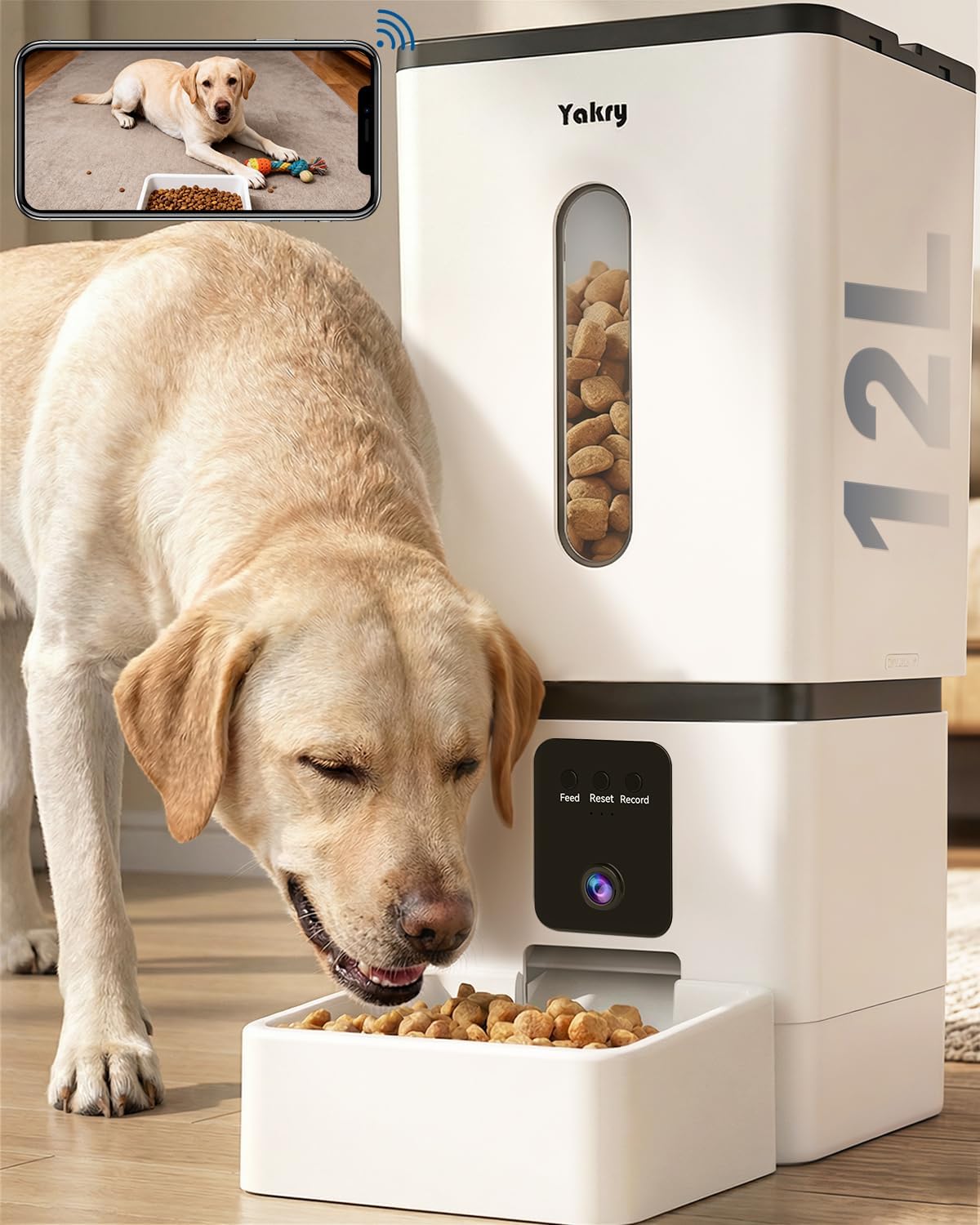
Manufacturers list capacity in liters or cups, and that number is close to meaningless without knowing your dog's daily intake. A 70-pound dog on a standard maintenance diet can eat 3 to 4.5 cups of kibble a day, sometimes more for working breeds. If you're gone for a long weekend and want the feeder to handle it, you need a hopper that holds at least 8 to 10 days of food without needing a refill, which as a rough estimate usually means 10L or larger for anything above 60 pounds, though this varies by kibble brand and density.
The math people skip: kibble density varies by brand. Large-breed formulas tend to be bigger, denser pieces, which means the same liter measurement holds fewer actual cups than a small-breed formula would. If a feeder advertises 50 cups at 12L, that number was almost certainly measured with a standard kibble size, not the dense large-breed blend your dog eats. Check reviews for owners with big dogs specifically, not just the aggregate rating.
Does the camera actually help, or is it just a selling point?
The camera earns its keep in two specific situations: confirming the feeder actually dispensed (mechanical jams happen more than brands admit) and watching for resource guarding or bloat symptoms right after a meal, which matters more for large and giant breeds prone to gastric torsion. Beyond that, most of the "talk to your dog through the app" features get used once or twice and then ignored. That's fine, it's not why you're buying this.
What you should actually check: night vision quality (1080p with decent low-light performance, not just a spec sheet claim), whether the app stores clips locally or requires a subscription for cloud history, and field of view wide enough to see the bowl and the surrounding floor. A camera that only shows the hopper opening is useless for the actual reason you wanted one.
Will the hardware survive a large dog's daily use?
This is where most buyers get burned. A big dog doesn't gently approach a feeder, it leans, paws, and sometimes headbutts the thing when the portion feels light. Look for these specifics before buying:
- Weighted or wide base — anything under 8 pounds empty will tip when a 70+ pound dog bumps it.
- Stainless steel bowl, not plastic — large dogs generate more saliva and more force chewing at the bowl edge, and plastic degrades faster and holds bacteria in scratches.
- Motor torque rating — cheaper units jam on dense, large-kibble formulas because the auger wasn't designed for bigger pieces. Owner reviews mentioning jams are the most useful data point you'll find, more useful than the spec sheet.
- Battery backup — a power outage shouldn't mean a missed feeding, especially relevant if you're feeding twice a day on a strict schedule for weight management.
What's marketing noise versus what genuinely matters?
App integrations, voice recording, treat-dispensing modes, and multi-pet profiles all sound good on a product page. Most of them are secondary to the two things that actually determine whether you'll still be using this feeder in a year: does the motor reliably dispense the correct portion for large-kibble formulas, and does the housing survive being nudged by a dog three times the size the engineers probably tested with.
Portion accuracy is the sleeper issue nobody talks about enough. If a feeder is off by even half a cup per meal, that's roughly 100 to 150 extra calories a day for a large dog as a rough estimate (the exact number depends on the kibble brand's calorie density), which can add up to real weight gain over a few months. Weight-related joint stress is already a known risk for large breeds, so a feeder that overshoots portions consistently is working against you, not for you. If you're already tracking a dog's weight for joint or hip concerns, a feeder that can't hold a portion within a few grams isn't actually a convenience, it's a slow problem.
What's the actual price-to-value math here?
Budget units in the $50 to $80 range typically skip the reinforced housing and use a lower-torque motor, which is exactly where large breed owners run into jamming and tipping complaints. The $100 to $160 range is where you start seeing steel construction, better app reliability, and motors rated for denser kibble. Above that, you're mostly paying for camera resolution and cloud storage subscriptions, which is a preference call, not a durability upgrade.
If you're also using a GPS tracker or containment system for the same dog, it's worth thinking about these as one connected setup rather than separate purchases, since app fatigue is real and most owners end up ignoring whichever app is clunkiest. If you're still narrowing down which containment option fits a large breed's strength and range, our guide to GPS trackers for large dogs covers the same durability questions from a different angle.
So what should you actually buy?
If you own a dog over 50 pounds, skip anything under 10L capacity and anything with a plastic-only bowl. Prioritize motor reliability over camera resolution, since a jammed feeder that misses a meal is a bigger problem than slightly grainy night vision. Read the negative reviews before the positive ones. This is the fastest way to spot recurring jam or tip-over complaints from owners with dogs your size, which tells you more than any five-star review from someone with a beagle.
This is a research-based buying guide, not a substitute for a veterinarian's input on your dog's actual caloric needs or any existing joint or digestive condition. If your dog has a medical reason for strict portion control, talk to your vet about the specific gram tolerance you need before trusting any automatic feeder to hit it consistently.
Editor's Pick
Affiliate link. We may earn a commission if you buy through it, at no extra cost to you.
More from Our Editors
Meta Quest 3S 512GB vs 256GB: How Much Storage Do You Actually Need?
By ReviewHubNow Editorial Team
Do You Need a Soundbar With a Built-In Subwoofer for a Small Room?
By ReviewHubNow Editorial Team
Ottocast Mini Cube 3.0 vs CarlinKit: Which Adapter Should You Buy?
By ReviewHubNow Editorial Team