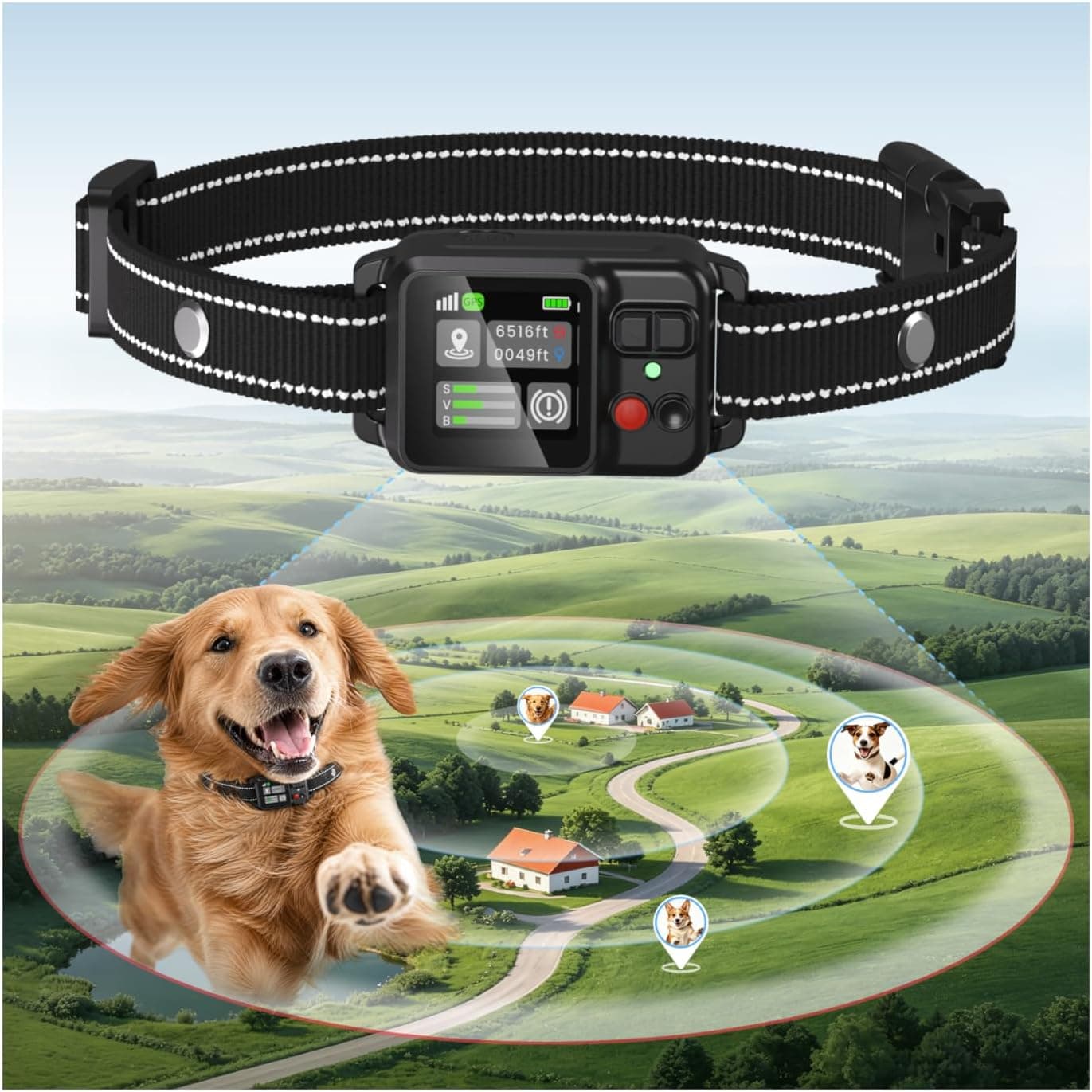
What Our Research Found
The question that matters here isn't whether the collar beeps when the dog crosses a line. It's whether a sub-$100 consumer GPS receiver can hold a boundary tightly and consistently enough to be called containment. That's a hardware question, not a marketing one, so that's where we started.
Consumer-grade GPS is typically accurate to a few metres under open sky. A virtual boundary can therefore drift by roughly the width of a suburban front yard, and no firmware update fixes that on a $93.99 collar.
The U.S. government's own GPS performance page puts GPS-enabled smartphone accuracy at around 4.9 metres under open sky, and notes that accuracy degrades near buildings, bridges, and trees. Dedicated fence collars can do somewhat better with faster fix rates and multi-constellation receivers. This listing never states which satellite constellations it uses, its update rate, its IP rating, its battery capacity, its static correction levels in volts or milliamps, or a minimum recommended dog weight. That's a long list of blanks for a containment device. What we can verify is the design pattern: set a centre point, pick a radius, and the collar escalates from tone to vibration to static as the dog nears the edge. Owners of this class of product consistently report that small radii behave badly. The boundary wanders, and a dog standing still can get corrected. Larger radii on open ground behave far better.
Bottom line
Treat it as a training and awareness tool rather than a barrier. On a wide-open acre or more, with a generous radius and a dog that already has decent recall, it does a reasonable job of teaching a soft edge for about the price of a good harness. On a quarter-acre lot beside a road, it's the wrong tool at any price.
The happiest buyers will be rural and cottage owners who want portability without a subscription. Anyone who needs reliable, tight, repeatable boundaries should install a wired in-ground system such as a PetSafe loop, or step up to a purpose-built premium GPS fence like SpotOn. Buyers who object to static correction on principle should skip the category and fence physically.
How wide is the drift band, and why does it rule out small yards?
We can't lab-test satellite accuracy, so we anchored the assessment to published, verifiable performance data for the underlying technology. The U.S. government's GPS.gov performance page states that GPS-enabled smartphones are typically accurate to within about 4.9 metres under open sky, and that accuracy worsens near buildings, bridges, and trees. Purpose-built fence collars can improve on that with better antennas, multi-constellation receivers, and higher update rates, but this listing publishes none of those details. The realistic working assumption is a several-metre uncertainty band around any circle you draw. Two consequences follow. First, the boundary you set is really a ring a few metres wide, which explains why a dog lying still just inside the zone can trip a correction. Second, the gap between your warning zone and the nearest hazard has to be wider than that band, which is exactly what rules out small yards and should drive your buying decision more than any feature on the box. On the correction side, we went to what animal-behaviour bodies publish rather than to marketing copy. AVSAB's general position favours reward-based training methods. That doesn't make the collar unusable, since tone and vibration modes exist for a reason, but it does mean the static function belongs at the end of the sequence, applied after proper perimeter training rather than in place of it. We also checked the regulatory angle: any radio-transmitting device sold in Canada needs Innovation, Science and Economic Development Canada equipment certification, and the unit should carry an ISED or FCC identifier. If yours arrives with no visible certification marking, that's a legitimate reason to send it back. Finally, our read of the aggregated public review pattern for this class of product is that satisfaction tracks almost entirely with property size and openness. Happy owners describe acreage; unhappy owners describe suburban lots.
The Good & The Bad
thumb_up What We Loved
- check
No trenching, no wire, no subscription
You skip the weekend of digging an in-ground loop and the recurring monthly fee that premium GPS fence brands like SpotOn charge. For a rental property or a seasonal cottage, that's the whole argument.
- check
Genuinely portable
The centre point moves with you. Campsite, in-laws' acreage, hunting camp: you reset the middle and you have a boundary again in a couple of minutes. Wired systems can't do that at all.
- check
Tone and vibration modes let you train without static
You can run the entire boundary-teaching phase, and in some cases ongoing use, without ever triggering a static correction. That matters, because AVSAB's general position favours reward-based training.
- check
Low financial risk at $93.99
Wired kits plus installation and premium GPS collars both sit well above this. If it doesn't suit your property, you're out under a hundred dollars and you've learned something about your yard's GPS coverage.
thumb_down Honest Drawbacks
- close
The boundary drifts, and that's the hardware talking
Budget receivers resolve position to a few metres at best, worse near trees and buildings, so the line shifts between checks. Expect occasional corrections while the dog is standing perfectly still. Treat the edge as a fuzzy band rather than a line.
- close
Almost nothing is specified
No IP rating. No battery capacity or runtime hours. No static intensity figures, no satellite constellation, no refresh rate, no minimum dog weight. For a device meant to keep an animal off a road, that's an uncomfortable number of blanks.
- close
Useless on small or obstructed lots
If your usable radius is small, or your yard is ringed by mature trees, tall buildings, or metal structures, drift eats the entire buffer. This product needs open sky and a lot of room before it's worth anything.
- close
A 4.9-star average on a generic listing deserves suspicion
Unbranded pet-electronics listings on Amazon frequently carry near-perfect ratings that don't survive a read of the actual review text. Re-badging is a known pattern in this category, with visually identical hardware appearing under several seller names, though we can't confirm that about this particular listing. Read the recent one- and two-star reviews first.
- close
Static correction demands training you may not do
The static mode only belongs at the end of a proper perimeter-training sequence, applied to a dog that already understands the boundary. AVSAB's general position favours reward-based methods, and an owner who straps this on and turns the dog loose the same afternoon is doing the animal real harm.
Technical Breakdown
Containment method
GPS radius from a set centre point; no buried wire
Correction modes
Tone, vibration, static; level count and intensity not stated
Battery life
Rechargeable; runtime and capacity not published
Water resistance
No IP rating published
Dog size and fit
Adjustable strap; no minimum recommended weight given
How It Works
Setup is genuinely quick compared with burying wire. The training half is where most owners underinvest, so here's the realistic sequence.
Charge and pair the collar
Charge the receiver collar fully before first use, then power up the handheld or app-side controller and confirm it's talking to the collar. Do this indoors, then step outside so the collar can acquire satellites. A cold fix outdoors can take a minute or two.
Set your centre point outdoors, in the open
Stand at the middle of the area you want to contain, ideally away from the house wall, tall trees, and metal outbuildings, and lock the centre. Anchoring next to a building is the single most common cause of a lopsided, drifting boundary.
Choose a generous radius
Set the radius larger than you think you need. Because the boundary can wander by several metres in either direction, a tight radius produces phantom corrections. If your space can't accommodate a wide buffer between the warning zone and a road or driveway, this product isn't a fit.
Fit the collar correctly
The contact points need to touch skin, snug enough that you can slide two fingers under the strap and no looser. Trim the strap, reposition it every few hours during long wear, and check the neck daily for pressure sores.
Train the boundary on tone only
Spend at least one to two weeks walking the perimeter on a long line with the collar set to tone or vibration only, rewarding the dog for turning back. Skipping this step is why dogs bolt through the zone and then refuse to come back in.
Supervise, always
Test the boundary yourself by carrying the collar to the edge on foot before trusting it. Then keep using it only while you can see the dog. A GPS boundary has no physical presence and does nothing to keep other animals or people out.
How It Compares
| Feature | Wireless Dog Fence GPS Collar Pet Containment System (Green) | PetSafe in-ground wired fence / SpotOn GPS Fence |
|---|---|---|
| Containment method | GPS radius set from a centre point in software | cancelPetSafe: buried or staked wire loop. SpotOn: satellite-defined zones, no wire |
| Installation effort | Minutes: set centre, set radius, fit collar | PetSafe: a day of trenching or staking. SpotOn: app setup plus an account |
| Boundary precision | Several-metre uncertainty band; degrades under trees and beside buildings | cancelPetSafe: tight and repeatable to within a step. SpotOn: purpose-built receiver hardware, still not wire-tight |
| Boundary shape | Circle only | PetSafe: any shape you can dig. SpotOn: custom drawn zones |
| Portability | Excellent; reset the centre anywhere | cancelPetSafe: none once installed. SpotOn: excellent |
| Ongoing cost | cancelNone disclosed; no subscription | cancelPetSafe: none beyond replacement parts. SpotOn: requires a paid plan |
| Published specs | cancelSparse; no IP rating, battery hours, or correction levels stated | Both brands publish IP ratings, runtime figures, and correction level counts on their spec pages |
| Best suited to | Large open rural lots, cottages, campsites, supervised use | PetSafe: suburban yards needing a tight edge. SpotOn: owners wanting custom zones and tracking who accept a subscription |
Frequently Asked Questions
Is a $93.99 GPS dog fence collar worth it for a large rural property?
Only on a large, open property, and only as a supervised training aid. At $93.99 it undercuts wired systems and subscription GPS fences, and setup takes minutes rather than a weekend. On a small or tree-covered lot, drift of several metres swallows your safety buffer and the whole thing becomes frustrating for you and confusing for the dog.
How accurate is the GPS boundary on a wireless dog fence collar?
Roughly 4.9 metres under open sky, according to official U.S. government figures for consumer GPS. Performance degrades further near trees, buildings, and metal structures. This unit doesn't publish its receiver specs at all, so plan your radius with a wide margin between the warning zone and any road.
Is this GPS dog fence collar waterproof enough for rain and swimming?
No IP rating is published, so treat it as splash-resistant only. The listing gives no measurable figure for water ingress protection, which matters a lot for a collar that lives in rain and mud. Keep it out of lakes and away from swimming until the seller states a rating in writing, and dry the contact points after wet walks.
How long does the battery last on a GPS containment collar?
If you're planning a multi-day camping trip, don't count on this collar getting through it. Neither battery capacity nor hours per charge appear anywhere in the listing, and GPS collars vary enormously depending on how often the receiver polls for a fix. Charge fully before each session and plan on daily charging during active use.
Can I leave my dog outside unsupervised with a GPS fence collar?
No. A virtual boundary has no physical presence, so a determined dog can run straight through the correction zone, and once it's outside the circle the collar has no way to bring it back. It also does nothing to keep other animals or people out. Use it only while you can see your dog.
GPS fence collar vs SpotOn: which works better for containment?
SpotOn wins if you need dependable containment; this collar wins if you only need cheap portability. SpotOn uses purpose-built receiver hardware and custom-drawn zones, but it sits in a far higher price bracket and charges a recurring plan. For a fixed suburban yard that needs a tight edge, a wired PetSafe loop beats both of them.
library_booksReferences & Further Reading
Our reviews are informed by peer-reviewed research and authoritative health organizations. These sources provided context for this review:
- linkGPS.gov — GPS Accuracy (U.S. Government)
- linkAmerican Veterinary Society of Animal Behavior — Position Statements on Humane Dog Training
- linkInnovation, Science and Economic Development Canada — Radio Equipment Certification
Editorial note: Links to external sources are provided for informational purposes. ReviewHubNow is not affiliated with these organizations and does not receive compensation for linking to them.
Judged as a fence, this fails, and so would every other sub-$100 GPS collar, because a few metres of satellite uncertain...
Based on our research and analysis, Wireless Dog Fence GPS Collar Pet Containment System (Green) scored 6.1/10. See the full verdict above for who it suits — and who should pass.
View Price on Amazon Canadaarrow_forwardVerify official availabilityWhat Owners Report
Recurring themes we found across public owner reviews.
Owners with acreage repeatedly describe the setup as the easiest part. Centre point set, radius dialled in, dog wearing it inside ten minutes, and it moves to a cottage or campsite without reinstalling anything.
The most persistent negative theme across this product class is phantom corrections and a wandering boundary, especially at small radii or under tree cover, with dogs beeped while lying still well inside the zone.
Reviewers who took perimeter training seriously, a week or two on tone only with a long line, report far better outcomes than those who fitted the collar and turned the dog loose the same afternoon.
Amazon Canada's standard returns window is typically 30 days from delivery for most items, but third-party sellers can set their own terms — check the specific listing and seller return policy before ordering, and keep the packaging until you've tested the boundary on your own property.