Best Waterproof Bluetooth Speaker for Pool Parties & Beach Trips
Before you spend money on a waterproof speaker, know what IP ratings, battery claims, and 'party mode' actually mean in practice.
ReviewHubNow Editorial Team
ReviewHubNow Editorial Team
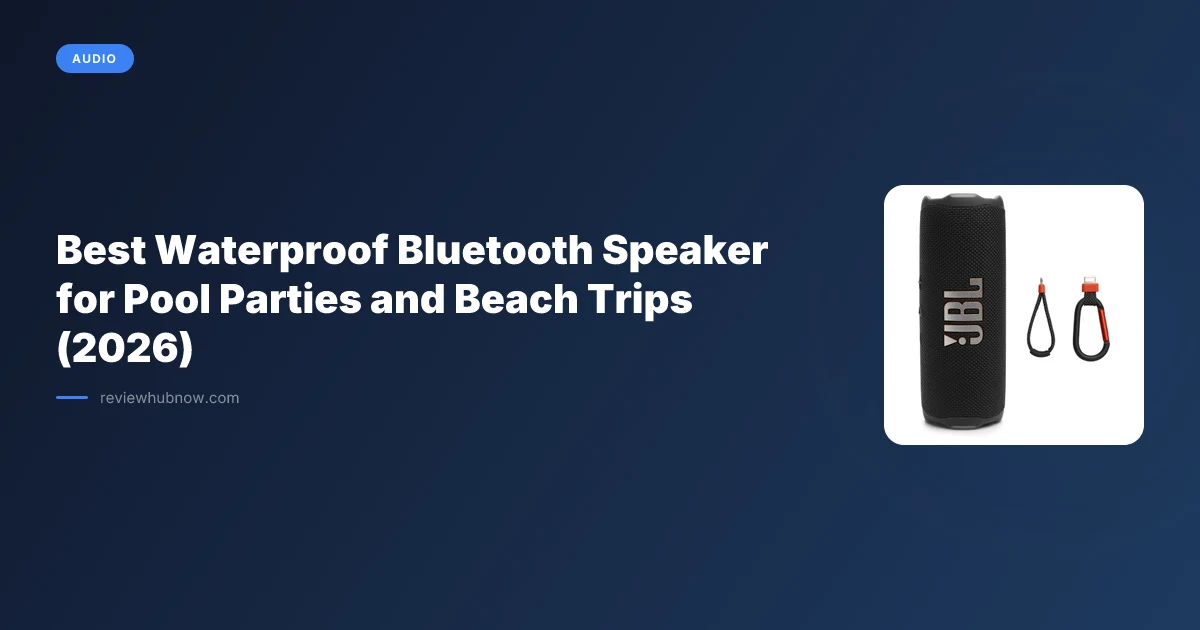
Before you spend money on a waterproof Bluetooth speaker, here's what you need to know: most of the marketing on the box is technically true and still misleading. A speaker can be legitimately waterproof and still be the wrong choice for a day at the beach. The difference between a speaker that survives your summer and one that dies in July comes down to about four specs that actually matter, and a dozen more that are just noise.
What IP rating do you need for a pool or beach?
IPX7 at minimum, and ideally a full IP67 or IP68. The rating is two digits: the first covers dust resistance, the second water resistance, and an X in the first position means dust protection was never tested.
IPX7 means surviving submersion in up to a metre of water for half an hour, which covers dropping it in the pool and retrieving it quickly. IP68 adds deeper submersion for longer along with full dust sealing, and that dust half matters more than buyers expect on actual sand rather than a clean pool deck. Sand works into ports and seams in ways a water test never evaluates.
Treat any speaker marketed as water-resistant with no specific IP number as a warning. The omission is rarely an oversight, and a company confident in its rating prints it.
How accurate are battery life claims?
Optimistic by a wide margin, because manufacturers test at moderate volume in ideal conditions without bass-heavy content. Nobody plays a pool party at half volume, since you are competing with splashing, conversation and everything else happening outdoors.
A speaker rated at twenty hours realistically delivers somewhere in the low teens at genuine outdoor volume, which still covers a full day. Anything rated under twelve hours on paper will need charging mid-afternoon, and that complaint appears reliably in owner reviews once people use a speaker across a season rather than a weekend.
Why does bass disappear outdoors?
Because there is nothing for it to reflect off. Indoors, walls and ceilings reinforce low frequencies, and outside those surfaces are gone, so bass that sounds full in a living room turns thin and directionless on a beach.
That physics explains why so many outdoor speakers ship with boosted bass baked into the tuning. It compensates for the environment rather than demonstrating superior engineering.
Speakers that genuinely perform outdoors tend to use dual opposing drivers or passive radiators pushing sound in several directions instead of a single forward-firing cone. JBL's Flip and Charge lines have built around this for years, and it is a real design decision. When one product lists its driver configuration and a competitor only promises powerful bass, that difference tells you which company engineered for the use case.
Does pairing multiple speakers work?
Yes, within limits worth knowing before you buy. Most brands allow two or more speakers to link wirelessly for stereo or louder group sound, and it works well enough to justify paying for if you host regularly.
The constraint is that pairing generally works only inside one product family, and sometimes not across generations of the same family. A speaker from one brand will not pair with another brand's. Anyone who wants this feature should commit to a single ecosystem deliberately rather than discovering the limitation later.
Do waterproof speakers float?
Not automatically, and the two properties are unrelated. A speaker with a dense battery and metal grille can carry a full IP68 rating and still sink immediately off a dock.
Buoyancy is a separate specification worth checking explicitly if there is a real chance the speaker ends up in the water rather than merely splashed, which is common around children and pool inflatables. The list of speakers that genuinely float is shorter than most buyers assume.
How much should you spend?
At the budget end you get a speaker that survives a splash and sounds acceptable to one person sitting beside it. That suits a solo afternoon next to a cooler and disappoints a group.
The middle of the market is where this category actually lives, with solid IP ratings, outdoor-tuned sound, real-world battery past twelve hours and pairing that works. The JBL Flip 7 sits here, refined across several generations specifically for grab-and-go outdoor use rather than adapted from an indoor design, and it carries a full IP68 rating covering both sand and submersion.
Larger models such as the JBL Charge 5 spend the extra money on volume and battery capacity, with bigger drivers, a larger cell and a power bank function for charging a phone from the speaker, which is genuinely useful on a beach with no outlets. Its IP67 rating brings full dust sealing with shallower submersion tolerance than the Flip's IP68, and at that size it functions as a small portable PA rather than a pocket speaker.
What is not worth a premium: voice assistants, app-based EQ and RGB lighting rings. None of it improves a pool party in any way that matters, and much of it consumes the battery you actually care about.
Which one should you buy?
For the common case, meaning pool afternoons and beach trips with a handful of people and the speaker moving around all day, the JBL Flip 7 is the straightforward pick. It clips to a bag, the IP68 rating removes any concern about sand or dunks, and the real-world battery covers a full day without watching a charger. It also avoids the size and weight penalty of bigger speakers whose extra capability rarely gets used.
Larger gatherings, group trips and weekends where volume matters more than portability justify stepping up to the Charge 5. The extra capacity and power bank function mean your phone survives the day even when everyone else's is buried in a bag, and the trade is bulk.
Anyone whose real goal is personal audio during a solo swim or a quiet beach read is shopping in the wrong category entirely, and a decent pair of noise-cancelling headphones serves that better.
Marketing in this category is loud while the meaningful differences are quiet and specific: IP rating, real-world battery and driver design. Get those three right and everything else comes down to preference.
Editor's Pick
Affiliate link. We may earn a commission if you buy through it, at no extra cost to you.

More from Our Editors
Meta Quest 3S 512GB vs 256GB: How Much Storage Do You Actually Need?
By ReviewHubNow Editorial Team
Do You Need a Soundbar With a Built-In Subwoofer for a Small Room?
By ReviewHubNow Editorial Team
Ottocast Mini Cube 3.0 vs CarlinKit: Which Adapter Should You Buy?
By ReviewHubNow Editorial Team