Best Noise-Cancelling Headphones Under $100 That Actually Work
Most budget ANC headphones oversell what they do. Here's how to spot the ones that actually cancel noise, and which ones under $100 earn the claim.
ReviewHubNow Editorial Team
ReviewHubNow Editorial Team
Before you spend money on noise-cancelling headphones under $100, here's what you need to know: most of the marketing copy on that box is describing a feature category, not a performance level. "Active Noise Cancelling" on a $40 pair and "Active Noise Cancelling" on a $350 pair are the same words attached to wildly different silicon, microphone arrays, and tuning. Nobody's lying, exactly. They're just letting you assume more than the spec sheet supports.
Under $100 you can get real noise reduction. Knowing what separates the genuine implementations from the label is what stops you overpaying for a feature name.
What does noise cancelling actually block?
ANC uses microphones to sample ambient sound and generates an inverse waveform to cancel it. It is genuinely effective against low-frequency, constant noise: engine hum, HVAC systems, airplane cabin roar, a leaf blower two houses down. What it handles poorly is sudden, high-frequency, irregular sound. Voices, a dog barking, a child asking the same question a fourth time. That limitation follows from how the technology works rather than from cost cutting, and flagship models struggle with speech too.
The practical consequence: anyone trying to block a snoring partner or a chatty office is closer to a solution with passive isolation and masking than with cancellation alone. Our guide to headphones for a snoring partner covers why the biggest ANC claim on the box is often the wrong thing to buy for that problem.
What separates good budget ANC from bad?
Three things separate the budget headphones that work from the ones that don't:
- Microphone count and placement. Cheap ANC often runs on a single external mic per ear. Better implementations use two, one external and one internal, to sample and correct in real time. That is the difference between muffled and gone.
- Driver size and tuning. A 40mm driver isn't automatically better than a 30mm one, but cheap tuning that boosts bass to mask a hollow midrange is a red flag. If bass overwhelms everything else the second you turn ANC on, that's compensation rather than quality.
- Battery life under ANC load. This is where budget headphones quietly cut corners. A pair claiming 40 hours total battery life might drop to 20 with ANC engaged. Check the ANC-specific number, not the headline number.
What matters less than brands imply: app-based EQ customization, adaptive ANC that claims to adjust to your environment, and multi-point Bluetooth pairing. The last one is genuinely useful and has nothing to do with cancellation quality.
Which headphones under $100 are worth buying?
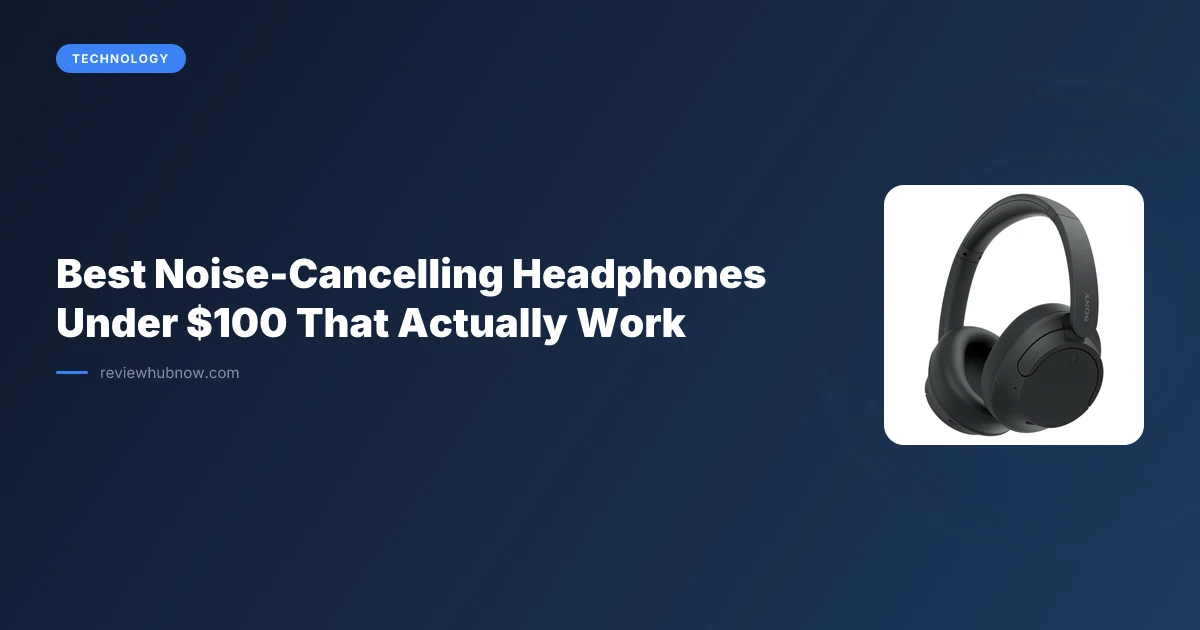
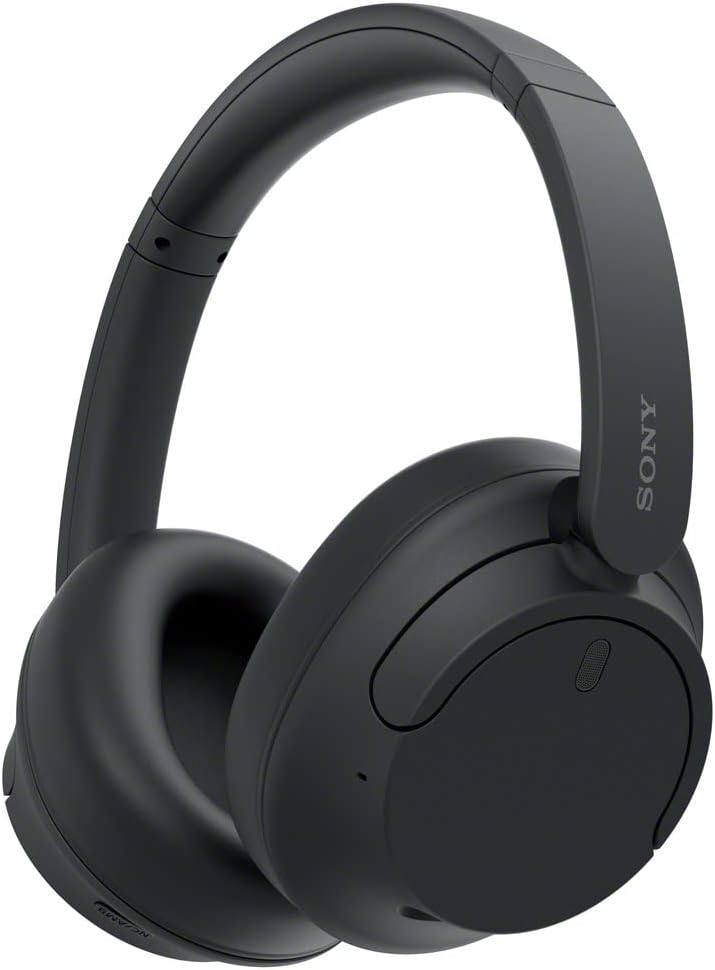
The Sony WH-CH720N is the clearest example of real engineering at this price rather than a feature name on a box. It runs a scaled-down version of the dual noise-sensor approach Sony uses in its pricier models, with fewer microphones and less processing headroom than the flagship line but the same basic sensing method. That translates into genuinely effective cancellation of low-end drone: HVAC, road noise, cabin hum. It will not handle conversational voices the way a flagship does. Compared against the Beats Studio Pro, the gap turns out narrower than the price difference suggests, which is worth knowing before assuming more expensive means better here.
The Soundcore Q20i is the pick for spending closer to $50. Anker has been quietly good at hybrid ANC for years, and this model performs above its price against constant low-frequency noise. Refinement is not part of the deal: there is a faint hiss floor if you listen for it, and the build feels like what it costs. For flights, commutes and open offices it does what it claims, which is more than a lot of headphones at twice the price manage.
Anyone who cares more about bass impact than cancellation, for gym use or walking, is looking at a different product. The Skullcandy Crusher Evo uses adjustable bass amplification instead of leaning on ANC, and our piece on what the research says about bass-heavy tuning covers that as a legitimately different use case rather than a worse one.
What should you avoid at this price?
Avoid anything advertising ANC without a decibel reduction figure or independent testing behind it. Be sceptical of on-ear designs claiming performance equal to over-ear models, since seal and cushion depth strongly affect how well cancellation works and on-ear designs fight their own geometry, with a few well-engineered exceptions.
And do not expect a $100 pair to match a $350 one because both print the same phrase on the box. It will not. It can get you most of the way for a fraction of the cost, which for most buyers is the right trade.
Which one fits your situation?
Frequent flying or constant environmental drone from traffic, office HVAC or a loud commute points to the Sony WH-CH720N as the strongest sub-$100 option. A tighter budget with tolerance for rough edges points to the Soundcore Q20i. A problem that is a person rather than a machine, such as a snoring partner or a loud roommate, is not solved by either, and passive isolation built for that scenario serves you better.
The realistic bar under $100 is not flagship performance. It is noticeable, reliable reduction of the noise actually bothering you without the sound quality collapsing to achieve it. Both options above clear that bar, and most of what sits beside them on the shelf does not.
Editor's Pick
Affiliate link. We may earn a commission if you buy through it, at no extra cost to you.
More from Our Editors
Meta Quest 3S 512GB vs 256GB: How Much Storage Do You Actually Need?
By ReviewHubNow Editorial Team
Do You Need a Soundbar With a Built-In Subwoofer for a Small Room?
By ReviewHubNow Editorial Team
Ottocast Mini Cube 3.0 vs CarlinKit: Which Adapter Should You Buy?
By ReviewHubNow Editorial Team