Blunt Tip Dispensing Needles: What They're Actually For And When
Blunt dispensing needles show up in medicine cabinets and craft drawers alike. Here's what the safety data actually says about when you need one.
ReviewHubNow Editorial Team
ReviewHubNow Editorial Team
This is not medical advice. This is editorial research, not a clinical recommendation. Talk to your doctor or pharmacist before starting, stopping, or changing any supplement or medical product, especially if you take medication or manage a health condition.
Search "blunt tip needles" and you'll get a confusing mix of results: nurses talking about medication safety protocols, hobbyists filling e-liquid bottles, people mixing epoxy resin, and pet owners giving oral meds to a cat who wants no part of it. That's not an accident. Blunt dispensing needles are a genuinely cross-purpose tool, and most of the confusion online comes from people conflating them with the sharp needles used for actual injections. They are not the same category, and using one where you need the other is where people get into trouble.
What the research keeps showing is that this isn't really a question about the needle itself so much as a question about the task. So let's separate what's solid evidence, what's reasonable practice, and what's just marketing noise on a product listing.
What is a blunt tip dispensing needle actually designed to do?
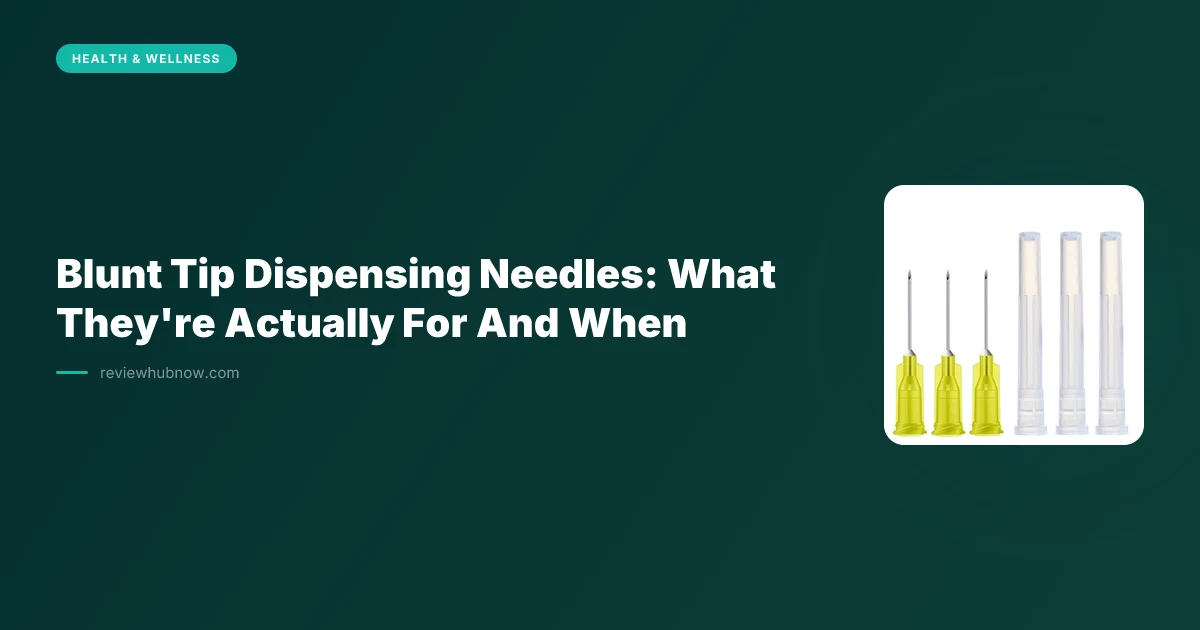
A blunt tip needle has a rounded, non-piercing end instead of the beveled point you'd see on a hypodermic needle. It attaches to a standard Luer lock or slip-tip syringe the same way a sharp needle would. The difference is entirely in function: it's built to move liquid into or out of a container, not through skin.
That makes it useful for a specific, narrow set of tasks: transferring liquid medication from a vial into an oral syringe, filling small dropper bottles, dispensing adhesives or lubricants in precise amounts, drawing up e-liquid, or administering oral (not injected) medication to pets. In clinical and pharmacy settings, blunt needles are also standard for compounding, because a sharp tip has no job to do when you're just moving fluid between two sealed containers.
Does the safety data actually support blunt over sharp for these tasks?
This is the part with real numbers behind it. Needlestick injuries are one of the most studied occupational hazards in healthcare, and the data is not ambiguous: the CDC and OSHA have documented that a large share of sharps injuries happen during activities that never required a sharp tip in the first place, like drawing medication from a vial. That's the exact use case blunt dispensing needles were engineered to eliminate. Hospitals that adopted blunt-tip cannulas for fluid transfer and IV access saw measurable drops in needlestick incidents in the studies that prompted the policy shift in the first place.
So the evidence here isn't preliminary. It's the reason blunt needles exist as a standard product category at all, not a wellness-brand invention. Where the evidence runs out is any claim that blunt needles are "safer" in a general sense outside of that specific transfer task. They're not safer for injecting anything, because they can't inject anything. A blunt tip can't reliably penetrate a rubber vial stopper or skin, and manufacturers don't design them to.
What gauge and length actually matter for the job you're doing?
Gauge numbers work backwards from what people expect: higher gauge means a thinner needle. A 30-gauge blunt needle is fine, hair-thin, and made for low-viscosity liquids like e-liquid, saline, or thin medications. Go up to 20 or 18 gauge and you're in territory suited for thicker fluids, adhesives, or anything with some resistance to flow.
Length matters less for dispensing than it does for injections, since you're not trying to reach a specific tissue depth. A half-inch needle is standard for most bottle-to-bottle or bottle-to-syringe transfers. The mistake people make is grabbing whatever gauge is cheapest without checking it against the viscosity of what they're moving. Too fine a gauge with a thick liquid means you're fighting the syringe plunger the entire time, and that's how bottles get knocked over.
If your actual task involves injecting medication into the body rather than dispensing it between containers, gauge and length selection works on entirely different criteria, and we've broken that down separately in our guide to choosing the right insulin pen needle length and gauge. Don't substitute one for the other based on what happens to be in the drawer.
When should you not use a blunt tip needle?
Never for anything that needs to go through skin, a vial stopper, or an IV port. A blunt needle physically cannot do the job a sharp one is designed for, and forcing it will usually just bend the tip or fail to penetrate at all. If you're administering an injectable medication, insulin, or anything prescribed for subcutaneous or intramuscular delivery, that requires a sharp needle rated for that purpose, full stop.
This is also where I'll say plainly: this article is research and product information, not medical advice. If you're unsure whether a medication is meant to be injected, given orally, or handled some other way, that's a question for a pharmacist or the prescribing doctor, not a needle gauge chart. Dosing errors and injection-site complications aren't something you troubleshoot by reading enough blog posts.
Is the sterile packaging claim on these products actually meaningful?
Mostly yes, with one caveat. Individually wrapped, sterile-marked needles are appropriate for anything touching medication, a wound, or an animal that's already immunocompromised. For craft or industrial use, like dispensing glue or resin, sterility is irrelevant and you're paying for a feature you don't need. That's a case where the "sterile disposable" label on the packaging is accurate but beside the point for your actual use. Read what you're buying against what you're doing with it, not against the marketing copy.
What I'd actually recommend
For anyone handling liquid medication transfer at home, pet care, or lab-adjacent hobby work, a multi-pack of 30-gauge blunt tip needles in the half-inch length covers the overwhelming majority of tasks people search for. They're cheap, disposable, and the gauge suits thin to moderate liquids without a fight. If you're regularly working with thicker substances, buy a second box in a lower gauge rather than trying to make one size do both jobs badly.
What I wouldn't do is treat a box of dispensing needles as a substitute for injection supplies, or assume "needle" is a single interchangeable category because the packaging looks similar. The engineering difference between blunt and sharp tips exists because the failure modes are different, and the safety data behind that split is about as solid as consumer health-product evidence gets. Match the tool to the task, keep injectable medication questions with a pharmacist, and you won't run into the problems that show up in the reviews from people who guessed wrong.
Editor's Pick
Affiliate link. We may earn a commission if you buy through it, at no extra cost to you.

More from Our Editors
Meta Quest 3S 512GB vs 256GB: How Much Storage Do You Actually Need?
By ReviewHubNow Editorial Team
Do You Need a Soundbar With a Built-In Subwoofer for a Small Room?
By ReviewHubNow Editorial Team
Ottocast Mini Cube 3.0 vs CarlinKit: Which Adapter Should You Buy?
By ReviewHubNow Editorial Team